Wednesday, July 25, 2012

My radical feminism has no room for hate speech

woman power
public domain, via Wikimedia
A while back, a feminist acquaintance on Facebook invited me to a radical feminist conference at the end of July in Portland, OR (USA).

I have identified as a feminist all my life, and as a radical feminist since first coming to understand what radical feminism is.  That hasn't changed in decades.

(See this recent blog post: "A very brief introduction to Radical Feminism," at http://aquakerwitch.blogspot.co.uk/2012/05/very-brief-introduction-to-radical.html.)


So I thought, Cool!  I'll check this out.

But in good conscience, I can't go.  And I can't in good conscience recommend it to other people, either.  In fact, I hope none of my friends or colleagues goes.  

Whyever not?

The organizers have expressed cissexism, transphobia, and outright hate speech toward transgender women.

From the invitation I received, I couldn't tell if transgender women were welcome.  So I asked, rather than assume welcome or not welcome. And the organizers reacted not just with cissexisst and transphobic language, but with outright hate speech.

Not just in response to me, but in response to other women who asked.

Here are some of my problems with this:
  • Hate speech promotes violence.
  • Hate speech against transgender women promotes violence against transgender women.
  • Hate speech against transgender women promotes violence against all women.
  • Hate speech against transgender women promotes violence against everyone who doesn't toe the line when it comes to gender stereotypes.

A few terms

I'm not an expert, and I'm not going to try to incorporate a thorough introduction to all these terms into this post.  So, for now / for going on with:

Transphobia:
http://civilliberty.about.com/od/gendersexuality/g/transphobia.htm

Cisgender, cissexism, cis privilege:
http://juliaserano.livejournal.com/14700.html

Stereotypes:
http://www.merriam-webster.com/dictionary/stereotype

Some more terms: cisgender, transgender, genderqueer

I'm a cisgender woman -- cis as in same or on the same side (http://www.merriam-webster.com/dictionary/cis-).

Put very, very simply, the body I was born into matches pretty much with my gender identity.

Not everyone is born into a body that matches with their gender identity. I know a number of transgender people -- trans as in across, or on the other side of (http://www.merriam-webster.com/dictionary/trans) -- and also a number of genderqueer people, who don't necessarily identify on a gender binary.

Again, I am putting all this very, very simply.  I'm not trying to do an exhaustive Introduction to Transgender and  GenderQueer Issues, just give anyone to whom this is brand-new enough to go on with, at least in terms of reading the rest of this article.

I studied chemistry as an undergraduate and as a post-baccalaureate student; the language of cisgender and transgender has always made sense to me.

I don't buy that it's language foisted onto women by a dominant majority, any more than I buy that the term straight is language foisted onto women by a dominant majority.

As cisgender women, we are part of the dominant gender majority.  And we enjoy cisgender privilege.  Just as straight women are part of the dominant heterosexual (and monosexual) majority.  And enjoy straight/heterosexual and monosexual privilege.  See above.

I wrote about this a little in a recent post ("Pagan values, feminism, and transgender women," at http://aquakerwitch.blogspot.co.uk/2012/06/pagan-values-feminism-and-transgender.html), and I'll expand on just one small angle of cisgender privilege for a moment: choosing to wear a skirt or trousers, and hair length.

As a cisgender woman, I have more freedom to choose to wear a skirt or trousers, and to choose to wear my hair long or short, than do my transgender sisters.  Because I am a cisgender woman, I face less censure -- including from other feminists -- than do my transgender sisters if I wear trousers or wear my hair short, if I don't conform to feminine gender stereotypes in my appearance.  Because I am a cisgender woman, I am also physically safer than are my transgender sisters if I wear trousers, or wear my hair short -- if I don't conform to feminine gender stereotypes in my appearance.  I am less likely to be assaulted or killed.

This is cisgender privilege. 

Another term: hate speech

Hate speech falls into two categories: that within the purview of the law, and that outside the purview of the law.  According to Wikipedia (http://en.wikipedia.org/wiki/Hate_speech):

Hate speech within the purview of the law:

...is any speech, gesture or conduct, writing, or display which... may incite violence or prejudicial action against or by a protected individual or group, or... disparages or intimidates a protected individual or group.

Gender identity is one of those characteristics.  

Hate speech outside the purview of the law -- ie, culturally -- is:

...any communication that vilifies a person or a group on the basis of race, color, ethnicity, gender, disability, sexual orientation, nationality, religion, or other characteristic.

Gender identity is one of those "other characteristics."  

My radical feminism does its best not to include cissexism or transphobia.

My radical feminism absolutely doesn't include hate speech.

Hate speech and violence

You may be thinking, "Oh, come on.  'Sticks and stones may break my bones, but words may never hurt me.'"  You'd be wrong.  Or, "Oh, grow up and put your big-girl panties on; what does it matter what words people use?"

It turns out, a lot.

no hate (black text hate in a red circle with slash through it)
public domain, via Wikimedia


Language that dehumanizes other human beings, that allows us to think of them as Other, as not-us, as not fully human, is what allows us -- even when we start out committed to non-violence -- to commit violence against those very same people.

Groups and movements that use dehumanizing language and language that vilifies other human beings are more prone to violence -- even when they begin with a commitment to non-violence; even when they believe they retain a commitment to non-violence.

The research has demonstrated this, over and over.

Our experience has demonstrated this, over and over.

(See "The growth of political violence in the United States, http://aquakerwitch.blogspot.co.uk/2009/06/growth-of-political-violence-in-united.html.) 

There is no place in my radical feminism for violence or for behaviors that promote it.  

For more on this, and the connection between hate speech against transgender women and violence, see my recent post for the Pagan Values Project, "Pagan values, feminism, and transgender women," at http://aquakerwitch.blogspot.co.uk/2012/06/pagan-values-feminism-and-transgender.html. 

Cisgender-only space?  Transgender-inclusive space?

So: I'm a radical feminist, and I'm a cisgender woman, and I'd been invited to a radical feminist conference.  And I couldn't tell if it was open to transgender women. 

I know a number of transgender women who are radical feminists.  Actually, most of the transgender women I know are feminists, and of them, many are radical feminists.  From my perspective as a cisgender woman -- worth not much in this situation -- this makes sense to me; from what several friends have said to me, and from what I've observed, feminist analysis is one of the only ways to make sense of many of life's experiences as a transgender woman.  But the point is, I'm not a transgender woman -- I don't have the authority of that experience.  My transgender sisters do. 

I also know a number of cisgender women, feminists and not, who are uncomfortable with transgender women in general.  And I know a number of cisgender women, feminists and not, who are uncomfortable with transgender women in women-only space.
 
I can accept this, even when it makes me sad, or uncomfortable, or angry, or confused, or empathetic.  Patriarchy and violence against women have damaged us all.  Some of the reasons are ones I can't help feeling are legitimate, even if they make me squirm.  Other reasons are ones I have trouble with, but try not to judge, or try not to judge harshly.

I remember when I was new to this and trying to sort out where my own integrity led me with respect to transgender inclusion.

(I read that now, and can't help reacting: as if transgender women are somehow separate and apart, "other," asking to be let in, and not in many cases women who've been right here all along.  Kind of like the situation with lesbians with NOW and the second wave of feminism in the US in the 1960s and 1970s.)

(More on that here:
http://outhistory.org/wiki/Radicalesbians#Other_Origins:_Homophobia_in_the_Women.E2.80.99s_Liberation_Movement)

Some women-only groups actively engage with this discomfort and struggle around the issue, or question, of whether their women-only space should be cisgender-only space or inclusive of transgender women.

I have been involved with groups that have handled this issue with the best of intentions and yet handled it poorly and painfully for all involved.  I have also been blessed to be involved with one group in particular where this issue has been handled imperfectly, but with grace, love, openness, and patience, and where I have learned a lot.

I have learned that it is absolutely possible for me, as a survivor of violence against women and girls, to be in women-only space with other women who have some characteristics (physical or socialized) that may trigger flashbacks to that violence, and feel quite safe.

This is a blessing.

This has also helped me sort out when I am safe in other environments where I am not in danger but where there are triggers.  What's more, it has helped me assess the situation more accurately when I truly am in danger.

This is helpful and useful.

I have also learned that it's possible for me to be in mixed-gender, woman-centered space, or mixed-gender, mixed-orientation, queer-focused space, and feel quite safe, because even if it's not women-only or queer-only, it's woman-centered or queer-centered.  

All of these things also allow me to be in space where my transgender sisters feel safe and have refuge -- and in mixed-gender queer-centered space, where my transgender brothers and genderqueer siblings feel safe and have refuge.   

This is very important to me.  

Some women-only groups refuse to engage actively with this discomfort and struggle around the issue, or question, of whether their women-only space should be cisgender-only space or transgender-inclusive.

Instead, they either sweep it under the rug, or outright declare that "women-only" absolutely and obviously means "cisgender women-only."

In short, that transgender women aren't women. That only cisgender women are women.

This really makes me uncomfortable. This is women, often feminists, collaborating with the oppression of another minority.  This is women, often feminists, collaborating with the oppression of other women.  This is participating in cissexism and transphobia.  This is not challenging our discomfort, not dealing honestly with our cissexism, our transphobia, and our discomfort.

Cisgender women don't get to decide who all women are.

Cisgender women don't get to decide who all women are, not any more than straight women get to decide who all women are.  When straight women have tried to do this in the past, lesbians and bi women and our straight allies have been very clear: this is homophobia, biphobia, and heterosexism, and it has no place in the women's movement and in feminism.

When cisgender women act as if we get to decide who all women are, we are being transphobic and cissexist, and this behavior has no place in the women's movement, in feminism, or in the lesbian rights movement.  Transgender women have been very clear about this.

As cisgender allies, we need to speak up loud and clear as well. 

Let me be plain: I don't have a problem with people who come to this issue with discomfort, own it, and deal with it.  I have my own learned transphobia and cissexism to confront; I try not to be too much of a hypocrite.

What I do have a problem with is when people are dishonest about their discomfort, and refuse to challenge it.

And I have a really big problem when people take their discomfort and turn it into hate speech and into physical action. 

Transphobia and cissexism have no place in the women's movement, in feminism, and in radical feminism.

Hate speech absolutely has no place here. 

Back to radical feminism and the conference I'd been invited to 

I know not all women-only space is open to transgender women or genderqueer women, and I couldn't tell from the information posted on the event's page if this conference is open to transgender women.

I thought it was better not to assume, in either direction.

So I asked.

And I got back a torrent of cissexist and transphobic hate speech from the organizers. 

And that's when I had a problem.  

(There were personal attacks on me as well.  Did you all know I'm in league with pornographers?  Me, either.  I've been learning so many things I never knew about myself from other people lately!)

What's more, when other women asked whether or not the conference is open to transgender women, they were met with cissexism, transphobia, and hate speech, their posts were deleted, and they were blocked from the event page as well.  For simply asking the question. 

So: I hope none of my friends or colleagues goes to this particular radical feminist conference in Portland, OR (USA) at the end of July.  Because regardless of whether you think women-only space should be cisgender-only or transgender-inclusive, I really don't want you to support cissexism or transphobia, and most of all, I don't want you to support hate speech.

(No, I'm not linking to their web page or anything else -- they don't need more traffic from me.  You can absolutely search for them, and find them, from the information I've given already.)  

To see screenshots of the language the organizers (and I) used, see below. Content warnings. 

Postscript 1: The sister conference in London has to find a new venue

It turns out a sister conference in London has been disallowed from the hall they had originally booked, for two main / three stated reasons:

  1. At least one of the conference speakers is known for hate speech (as defined, and illegal, under UK laws)
  2. The conference is in violation of the UK's Equality Act (http://homeoffice.gov.uk/equalities/equality-act/)
  3. The conference could not assure the hall that they conformed to Conway Hall's Terms and Conditions of rental 

Conway Hall had posted a statement regarding the conference; it's no longer available on their website, but I did read it while it was still posted.  This excerpt is available at TransGriot (http://transgriot.blogspot.co.uk/2012/06/transphobic-radfem-2012-hatemongers.html):

In consultation with the organisers of [Conference] and our legal advisors, Conway Hall has decided not to allow the booking in July 2012 to proceed. This is because it does not conform to our Terms and Conditions for hiring rooms at Conway Hall. In addition, we are not satisfied it conforms with the Equality Act (2010), or reflects our ethos regarding issues of discrimination.

We had sought assurances that the organisers would allow access to all, in order to enable the event to proceed at the venue. We also expressed concern that particular speakers would need to be made aware that whilst welcoming progressive thinking and debate, Conway Hall seeks to uphold inclusivity in respect of both legal obligations and as a principle.
 

In the absence of the assurances we sought, the event in its proposed form could not proceed at Conway Hall.

Hmmmm.

Postscript 2: Just what do I mean? Exactly what I said and exactly what they said

Content warnings.

|
|
|
|
|
|
|
|
|
|
|
|
|
|
|
|
|
|
|
|
|
|
|
\ /


If you are having trouble reading the screenshots, you can click on them for larger versions.  (When I made them larger, they got buried under the sidebar.)

--------------------

1)  My question and Samantha's answer:


"It's a conference for radical feminist women only..."  Clearly implying that transgender women and radical feminist women are obviously mutually exclusive groups.

"I would consider... only that one and only because of the previously expressed interest in supporting radical feminists and radical feminism."  Note the individual exception rule: specific, individual transgender women might be found acceptable if they meet Samantha's bar.  This is a level of acceptability that cisgender women do not have to meet: if a cisgender woman claims she's a radical feminist, that's enough.  But if a transgender woman claims she's a radical feminist, she has to meet additional qualifications: she has to prove to the organizers she feminist enough.   This is cissexism and transphobia right here.  

Note Samantha's lack of gender-specific pronoun use, implying that transgender women are not women to her.  

--------------------

2)  Kat's answer and further discussion (up through "You cannot possibly presume..."):


There are so many problems with Kat's statement(s), I scarcely know where to start.

First off, human rights are human rights, regardless of what any majority thinks.  Most radical feminists would agree that whether or not the majority of people in the US or the UK (or the world) think sexism is a problem or not, it's a problem; and that whether or not the majority of people in any given population think female genital mutilation is a violation of human rights, it's a violation of human rights.

Note Kat's refusal to use the term "transgender woman," and her insistence on using the term "trans identifying male born person."  Kat makes it very clear that she does not consider transgender women to be women.  Instead, they are "trans identifying male born person[s]."  I wonder how she would react if someone insisted on calling her a "cis-identifying female-born person" rather than a "woman."

To Kat, not only can't a transgender woman be a woman, she can't be a radical feminist herself -- she has to be "pro radical feminist," relegated to a supporting role -- "support the conference in other ways, e.g. by distributing publicity."  Transgender women are lower than second-class citizens.  I don't know about you, but this reminds me of a lot of other experiences in our history -- women and African-Americans in the New Left, just for one.

"Most trans identifying people are not radical feminists" --
  • Kat would know this how --?  From extensive personal friendships with transgender women?  From extensive reading from works of transgender feminists?  (Most transgender women I know are feminists, and a good number are radical feminists.)  
  • Um, hello, most cisgender people are not radical feminists, and most women aren't radical feminists.  Maybe she shouldn't let cisgender people or women into the conference, either. 
  • And again, why would whether or not the majority of transgender women are feminists be relevant?  
  • Beyond that, if most transgender women aren't radical feminists, then those who are need radical feminist space pretty desperately. 

-- "because the ideology of trans is in direct conflict with the ideology of radical feminism" -- uh, what???  Right.  There's an "ideology of trans."  There's one "ideology of trans."  This one just... blows my mind.   

At the same time, I was having a conversation about all this on my own Facebook Wall.  At this point, I reported the event for hate speech and mentioned that in the conversation on my own Wall.  

Samantha quoting me: privileged information from the conversation on my Facebook Wall.  (Yes, I have since unfriended Samantha.) 

Samantha on how I lecture people about pornography: ...  .  Actually, I don't need to say anything about this at all.

(I take that back.  I will say this, because it's over the top and I can't resist: Elspeth Potter is a personal friend and claims to still have the negatives.)  (http://www.victoriajanssen.com/bookshelf/)  (...Wait, you thought radical feminists have no sense of humor?)

--------------------

3)  From "Go figure..." up through my explanation:


Speaks for itself, I think...

--------------------

4) Samantha's response; more hate speech; Kat's proposal to delete:


Red herrings.


Here's my other big question now, besides how deleting this whole conversation (which they did) wouldn't be censorship:

If this whole conversation wasn't hate speech, why the need to delete it -- ?  Why not leave it up for it to show itself, for it to demonstrate -- to Facebook, to radical feminists, to anyone who'd read it -- how exactly what they said was just fine?  

Hmmmm.


Anyway, there you have it.

Tuesday, July 24, 2012

Sally Ride: Those Who Have Gone Before and "Heroes"

The Ann Reed song "Heroes" was much in my mind during FGC Gathering this year.

In part, because Those Who Have Gone Before, and Those Who Will Come After, were much on my mind and in my heart during Gathering: my, and our, Ancestors and Descendants, spiritual and genetic; those who have inspired and will inspire me, those who have paved the way, those who have given me life in so many ways, those to whom I owe in some sense the work of my life, of my hands, of each day, to whom I am obligated in many ways small and large.  Those who have inspired me and to whom I owe it not to give up.  Those who have taught me joy.

My grandmother is one of those people.  She was very much with me.

People who were present at Gathering are some of those people.

"What can I learn from you...?"

I learned today of Sally Ride's death.

Dr. Sally Ride is one of those people for me, for all of her life, but especially when I was in high school and college.  She is also one of the women named in Ann Reed's song.

What can I learn from you?
In your lifetime, in what you've been through?
How'd you keep your head up and hold your pride
In an insane world how d'you keep on tryin'

One life can tell the tale
That if you make the effort, you cannot fail
By your life you tell me it can be done
By your life's the courage to carry on (to keep on tryin')

...Sojourner Truth, Eleanor Roosevelt,
Katharine Hepburn, Sally Ride
Susan B. Anthony, Harriet Tubman
Annie Sullivan, Gertrude Stein...    

Today, I also learned that Sally Ride was a lesbian, and that she and her partner had been together for 27 years.

I hold her and her partner, Dr. Tam O' Shaughnessy, in my heart with tenderness.


UPDATE, 25 July:

If you read only one article about Dr. Sally Ride, please read this one.


"The Astronaut Bride," by Amy Davidson
http://www.newyorker.com/online/blogs/comment/2012/07/the-astronaut-bride.html#ixzz21e8IDKU3

Thursday, July 19, 2012

"Travelling, travelling..."

I recently spent two and a half lovely weeks in the US, first at FGC Gathering, then on vacation (holiday) with F/friends, then a short visit with family. 

This was the first time I'd been back to the States since moving to the UK, and I wasn't sure what to expect.  Would I desperately wish to be back in the US, or desperately wish to be back in the UK?  Neither?  Both?  How would I react to the land/landscape back on the East Coast?  How would I react to the land/landscape when I got back here? 

I had a really good trip.  Our time with F/friends was wonderful and blessed, and fed me so deeply spiritually.  Our vacation both rested me and fed me, too.  Visiting Beloved Wife's grandfather and his partner was also good.  Meeting for Worship someplace I'd never been, but where there were some F/friends we know and love, was a delight.  Coming back to Edinburgh was also happy. 

I'm looking forward to sorting through some of what I learned at Gathering (http://fgcgathering.org/) this year.  I got all sorts of kicks in the pants from the Goddess, in a number of interesting ways, but the main thing that stays with me, that I am bringing back to my life and work in Edinburgh, is joy.  Blessed joy. 

Tuesday, July 3, 2012

In honor of FGC Gathering 2012: All God's Quakers Got a Place on a Committee

The theme for this year's Gathering of Friends General Conference (http://www.fgcquaker.org/connect/gathering) is "All God's Critters Got a Place in the Choir." 

In honor of this, I re-present an old post, from University Friends Meeting at North Pacific Yearly Meeting Annual Sessions a few years ago -- "All God's Quakers Got a Place on a Committee." 

It starts like this:

All God's Quakers got a place on a committee
We don't care if you're plain or pretty...

Click here for the rest...

Wednesday, June 20, 2012

Pagan values, feminism, and transgender women

This is my contribution to the 2012 Pagan Values Project.  For more information about the Pagan Values Project, please see http://paganvalues.wordpress.com/.   

Non-violence and eco-feminism

I'm a Witch and a Quaker.

Non-violence and eco-feminism are essential parts of my life.

(I've written about this in detail before, including in my contribution to the Pagan Values Project in 2009: http://aquakerwitch.blogspot.co.uk/2009/06/my-pagan-values-my-quaker-values.html.)

Because non-violence and eco-feminism are central to me, I don't support -- and I do challenge -- violence and behaviors that lead to violence.  I support, encourage, and participate in non-violent conflict resolution.  I participate in community that promotes non-violence, teaches it, and tries to live it, amongst ourselves and in the wider world.  I have training in both verbal and physical non-violent conflict resolution, and have trained and co-trained others in these methods.   I have put my own life at risk in peace witness, and as part of and in support of non-violent activism, both at home and in other parts of the world.

So, no, this is not just an airy theory to me.

This is real life. 

And one of the things I challenge because it leads to violence is hate speech.

What do I mean by "hate speech"?

There are two main categories of hate speech -- the kind that's covered by the law, and the kind that isn't. 

According to Wikipedia (http://en.wikipedia.org/wiki/Hate_speech):

The kind of hate speech that is covered by the law is

...any speech, gesture or conduct, writing, or display which is forbidden because it may incite violence or prejudicial action against or by a protected individual or group, or because it disparages or intimidates a protected individual or group. The law may identify a protected individual or a protected group by race, gender, ethnicity, disability, nationality, religion, sexual orientation, gender identity, or other characteristic.

The kind of hate speech that is not covered by the law is

...any communication that vilifies a person or a group on the basis of race, color, ethnicity, gender, disability, sexual orientation, nationality, religion, or other characteristic.


This is over-simplified, but provides enough of a background for purposes of this piece. 

How does hate speech lead to violence?  

Hate speech dehumanizes other people, and thereby leads to violence -- by allowing us to come to see them as less than human, as deserving of violence.  Dehumanization allows us to come to believe eventually that what happens to them doesn't "count" as violence towards other people

The research on violence and violence prevention, and experience within the eco-feminist and other political and spiritual and religious movements, demonstrates this, over and over.

  • When we make the effort to remind ourselves of the humanity of other people -- other people we don't like, other people who make us uncomfortable, other people who challenge us, other people who scare us, other people who make us squirm -- we reaffirm a commitment to non-violence.  Even more importantly, we are doing something concrete to ensure that we are less likely to commit violence against other human beings -- other expressions of That-Which-Is-Sacred. 
  • When we use words that trash other people, words that support some people as deserving of violence, words that support other people's violent behavior against certain people, words that dehumanize other human beings, words that refer to other people as animals or objects or trash...  We are engaging in behavior that promotes violence. 

If you'd like to read more about how how reinforcing humanity works to prevent violence, and dehumanization works to increase violence, see http://aquakerwitch.blogspot.co.uk/2009/06/growth-of-political-violence-in-united.html.

Talking about transgender women

Recently, in particular, I have come across a wide range of language used in reference to transgender women.

Because of this, I'm going to speak about transgender women specifically right now; but almost everything I say is also true of transgender men, genderqueer people/people who don't fit the gender binary, as well.

I know that many people who are uncomfortable with transgender women, and make disparaging jokes about transgender women out of that discomfort, think nothing of it.

I know that many people who insist on using their own words for the experience and bodies of transgender women, instead of the words that transgender women themselves choose, think nothing of it -- or even believe that they are doing something positive.

I know that many people who use derogatory language for or towards transgender women think it's no big deal, or it's harmless, or that they are somehow defending themselves.

I know that many people don't think these things are hate speech. 

They're wrong.

  • These things are hate speech.  They disparage an entire group of people based on their gender identity. 
  • These things are not harmless; they are dangerous.  This behavior dehumanizes transgender women.  Dehumanizing transgender women promotes and encourages violence against transgender women. 
  • Dehumanizing transgender women promotes and encourages violence against all women.
  • Dehumanizing transgender women promotes and encourages violence against everyone who does not conform to a particular set of gender stereotypes

Gender stereotypes and feminism

One of the aims of feminism has been to help women -- and not just women -- resist gender stereotypes, and make choices based on what we like and what's good for us, rather than have our choices limited based on what society says is appropriate for arbitrary categories of gender.  Things like "girls," "boys," "women," and "men."

What should determine whether I wear a skirt or trousers -- what I like, the weather, and what I'll be doing while wearing my clothing, right?  What should determine the length of my hair?

My gender should just not be relevant to these choices.  Neither should anyone else's.

However, my gender is still relevant, and I am sanctioned for making choices too far outside my culture's stereotypes for my gender.

Society holds transgender women to even stricter adherence to gender stereotypes than it does cisgender (non-transgender)* women.  (So do many feminists, something I find ironic.)

(*Cisgender as non-transgender: Again, this is over-simplified, but should be enough for this post, for now.  I will give a more in-depth treatment of this in another post soon.)

Hate speech towards transgender women in feminism

Many transgender women are feminists.

Many cisgender feminists are supportive of transgender women and transgender feminist women.

Many cisgender feminists are uncomfortable with transgender women and transgender feminist women.  Some are challenging their discomfort; some are not.

But there are some cisgender feminists who take their discomfort to extremes.

One of the places I've come across some of the most derogatory language towards transgender women again recently -- outright hate speech -- is within feminist communities. 

Speaking  up

As a feminist, as a Quaker, as a Witch, it is my job to speak up when people in my communities use language, especially hate speech, that promotes violence against women, period.

And it is my job to speak up when people in my communities use language, especially hate speech, that promotes violence against transgender women.

So I am speaking up:

Hate speech against transgender women -- NOT consistent with my Quaker, lesbian, radical eco-feminist, Pagan values.  

It's time to for all of us who are allies to speak up.   

~~~~~~~~~~~~~~~~~~~~~~~~~~~~~

The Sun is a mass! Happy Summer Solstice!

This has been stuck in my head for days now:

The sun is a mass of incandescent gas
A gigantic nuclear furnace
Where hydrogen is built into helium
At a temperature of millions of degrees

Yo ho, it's hot! The sun is not
A place where we could live
But here on earth there'd be no life
Without the light it gives

Umpteen years or so ago, I was delighted when National Public Radio played this in honor of Summer Solstice:


Now, of course, there's an updated version:


Enjoy!


Tuesday, June 19, 2012

Western Friend, June 2012: "Friends, Prisons, and Restorative Justice"

Acquaintances often ask me about restorative justice.  The current issue of Western Friend, June 2012 focuses on prisons and on restorative justice.  http://westernfriend.org/magazine/current-issue/

Check it out! 

Thursday, June 14, 2012

Two upcoming events

Two upcoming ministry events that I wanted to share.  Both are at Friends General Conference Gathering in Kingston, RI in early July; one is open to the public.

Wednesday evening, 4 July
Interest group at FGC Gathering

John Hunter of NC and I will be merging/co-leading the following two interest groups:

Theological Diversity Within Our Meetings - A great Strength of Quakerism
We all "have a place in the choir" at our home meetings.  This is true even as we may hold different personal theological beliefs.  We will explore how unity in such diversity might be a great strength for Quakerism.  A presentation will be followed by small groups where we each may explore our own theological assumptions and how we are included in our meetings and in the wider body of Friends.

Every Quaker Has a Place in This Meeting
Three Friends walk into Meeting for Worship: a Christian, a Pagan, a Jew, a Buddhist, a Non-Theist.  Each gives vocal ministry from their own experience; all experience gathered worship.  Come create the rest of the story: coming together, supporting each other, building community, helping each other sing in our own unique voices, singing in harmony. 


For more information, see:

Friday evening, 6 July
"The Fire and the Hammer"
Open to the public!

I'm singing in "The Fire and the Hammer," a major choral work about early Quakerism in England. 

This major choral work composed by two British Friends has been performed on both sides of the Atlantic on a number of occasions, most recently at the 350th sessions of New England Yearly Meeting last August. Dramatic passages from The Journal of George Fox alternate with songs based on these excerpts to provide a powerful glimpse into the Quaker movement that swept across England in the 17th century. New England Friends that formed the choir last summer will be joined by Friends from around the country, rehearsing together the weekend prior to the gathering.
For more information, see:

Tuesday, June 12, 2012

Photography exhibition in NYC: Women of Power

Polish, Pagan, powerful.

Katarzyna Majak explores the power of women as she searches for female wisdom and plurality of spiritual paths hidden within monoreligious Polish society.  Majak’s Women of Power series turns stereotypical witch imagery on its head and showcases striking images of women ranging from their 30’s to 80's, wearing colorful unconventional clothes, and holding their unique objects of power. When asked what being a witch meant to one of the subjects in the series, she replied ‘A witch is a woman of knowledge who takes a broom and sweeps to cleanse the world.’

Solo exhibition by Katarzyna Majak
Porter Contemporary
548 West 28th Street
New York, NY 10001 USA
May 31 through July 14, 2012
Opening reception with the artist on May 31, from 6:30 - 8:30 PM

Information about the exhibit, the story of how Majak came to take these photographs, and some images, at:

More images at: 
(If you hover near the top of each image, you'll see a caption.)

Blessed be!

(h/t Jason Pitzl-Waters.)

Tuesday, May 29, 2012

An explosion of light

One of the things for me about living someplace new is learning the cycle of the seasons in the new place.  The rhythms of the light, the plants, the animals.

My first winter in Edinburgh felt longer and harder than I expected.  I know one of the medications I'm on completely messes with my thermo-regulation, but still!  I thought I was reasonably cold-hardy, after some of the places we've lived during winters in the US.  Hah. This winter made me feel like a cold wimp.  Winter in Edinburgh is cold, damp, raw, and dark.  At Winter Solstice, there weren't even seven whole hours of daylight

And then, about a week after Brigid, there was a sudden explosion of light.  It wasn't just that the days were longer and I noticed it, it was that Wow, there seemed to be so much more light! 

Beloved Wife and I have been noticing a similar change again starting right around Beltane.  Wow!  Once again, there is so much more light! 

I first noticed this when I woke up one morning to use the bathroom and it was not just light out, but bright.  Usually when this happens, it's about 6:00 am, and I have just enough time for a snooze before the alarm goes off.  I looked at my watch.  5:00 am.  5:00 am??

Unfortunately, the cats noticed the sun was up, too, and they thought it was a fine thing...

We've started closing the shutters when we go to bed, to block the morning sun so that we might actually sleep until the alarm goes off. 

Then we noticed the light in the evening. At Beltane, sunset was a little before 9:00 pm, and it was dark enough by 9:30 that the Beltane Fire Festival folks started their pyrotechnics then.  Now it's still fully light at 9:00 pm

This is delightful.  But confusing to my inner clock.  Yay, vitamin D!!  But it is hard to convince myself it's time to start winding down and getting ready to bed when it's still bright out, or cloudy but fully light.  Things will be interesting come Summer Solstice, when the days are really long.

For now, I am reveling in this delightful explosion of light and in getting to know this time of year in this place.  Blessed be.

Monday, May 28, 2012

Busy hands; centered worship; the web of community

I was in a meeting recently of a clearness committee I'd agreed to serve on.

Before we started, I said something along the lines of, "I just want to share with you all that if I crochet during our worship together, it's not disrespect; it's that with my disability, it helps me listen better.  I know there's been some talk -- not among this group here, but in the larger community, and so you may have heard it -- about my crocheting in worship.  So..."

The more I talked, the more shocked they looked.  I trailed off.

Our convenor, a strong and powerful woman, shared, in a way that was somehow serene, tender, and no-nonsense all at once, about someone she knows who has a learning disability, but as soon as she has something to do with her hands, can quiet and center herself. 

It was very clear I didn't need to explain myself.  These women completely understood and supported my doing handwork while we worshiped and worked together.

I felt held in the Light, and in the web of community.

Tuesday, May 22, 2012

So, how did the Conference go??

I had a lovely time at the Scottish Pagan Federation Conference.  I'm glad I went.  Many thanks to the organizers for all their work!  

Somewhat at the last minute, a group of us, all from Reclaiming, tabled together with and for a handful of things:

This was nice, because it gave us a "home base"; the chance to meet people who came by, for those of us who hadn't been before; a chance to visit with each other between workshops and talks; a place to store supplies for later; etc.  It was also fun. :)

For me, it was also the least-stressful experience tabling I've ever had.  I think this was due in large part to the wonderful people I was tabling with, especially the ever-creative and highly-practical Lady of the East Wind.  (That's how I've decided to refer to her here, for now, especially as she stood East in our circle.)

I did not make it to all the talks, workshops, and performances I wanted to, but the ones I did make it to, I really enjoyed.  It was also lovely just to meet people and talk to people, and watch the crowd, watch people greet old friends and watch people greet newcomers...

There was also something else a little unexpected, perhaps because it hasn't happened for me in a long time in a group with other Pagans: that feeling of being with my people, among my tribe. Sometimes when I hang around with other Pagans, even when they're a great group of people or wonderful individuals whom I like, I feel like a space alien. But last weekend, I had a feeling of homecoming, and I appreciated that. 

We packed up our table and got ready for ritual.  How did that go?  I'm not ready to say too much about it yet, because we haven't had our debrief/processing meeting yet, but I can say that I had a lot of fun, I had a deep experience, I loved working with this Priest/essing team in circle, and that the folks who came and participated in the ritual were a pretty great group.  I had some moments of awe and magic.  I feel like I was faithful in my service to the Goddess.  Oh, and the ribbon wands were great! 

And Margot Adler can dance.  

Oh, yeah, and you know what else?  I'd never been part of a circle before where there was impromptu ceilidh dancing during energy-raising, but I have now! Hurrah, Scotland!

Monday, May 21, 2012

A very brief introduction to Radical Feminism

Or, "Yes.  I can still say with integrity that I am a radical feminist."

When I was enrolled in the Women's Studies Program at UMBC more than 20 years ago now, one of my all-time favorite courses was Theories of Feminism with Dr. Carole McCann.

It was a revelation.

I was already a feminist, but formal study of the feminist theory awed and astonished me.

public domain, via Wikimedia
I worked hard in that class, and I loved it.  The analysis that made even further sense of my real life and my experience, and also of so much more; the theoretical wranglings; the combination of mental gymnastics and hard practicality.  Learning and applying the rigors of feminist analysis.  Seeing how it all fit together.  The power of how it could be taken so much further.  Developing my sense of where I fit in with those who had gone before, and with the feminists I found around me -- my teachers, my sister students, activist friends in the community.

That level of feminist theory and analysis was not something I'd experienced when I was at Bryn Mawr the first time around. 

I was furious and crushed over having been forced to leave Bryn Mawr by the effects of sexual assault, by illness, by unthinking sexism in medical care, and by money and class.  I'd had to fight so hard to go to college in the first place, and then I'd had to leave.  Then I had to fight all over again to return to college, at UMBC.  And on top of it, I had to put up with the most incredible casual sexism on campus there.

And here was this silver lining, this life-changing, powerful, unexpected silver lining.  Not only in the form of the Women's Studies Program (now Gender and Women's Studies), but in all the courageous women -- in so many of my classes, not just my Women's Studies classes, and in the Women's Union and Students for Choice -- and in the courageous people of all genders, but especially the women, in the Gay/Lesbian Organization (which we got renamed the Lesbian, Gay, and Bisexual Alliance).  In the levels of engagement and activism. 

It was a revelation.

And as happy as I was when I managed to return to Bryn Mawr and complete my degree there, I really missed my sisters and the Women's Studies Program at UMBC, as well as in the wider peace and social justice activist community in that area.  

I still have all my reading materials from Theories of Feminism, in a box which came with me to Scotland.*  Including radicalesbians' "The Woman-Identified Woman," which I invite you to read here: 

radicalesbians, "The Woman-Identified Woman" 

Click here for the herstory of radicalesbians.  It rocks. 

I still identify as a feminist.

Frequent readers of this blog are unsurprised.

I have also said all along that I still identify as a radical feminist.

But when I was recently invited to a radical feminist conference where I found myself in such serious disagreement with the organizers that I not only can't imagine going, I can't imagine promoting the conference to anyone else, I found myself wondering:

Does my 20-odd-years-older self really still identify as a radical feminist?  If I look at radical feminism square-on, is that me?

So today, I went digging.

from the Wikipedia page on "Radical feminism":
(http://en.wikipedia.org/wiki/Radical_feminism)

Radical feminism is a current theoretical perspective within feminism that focuses on the theory of patriarchy as a system of power that organizes society into a complex of relationships based on an assumption that male supremacy[1] oppresses women. Radical feminism aims to challenge and overthrow patriarchy by opposing standard gender roles and oppression of women and calls for a radical reordering of society.[1]

Yep, that sounds like me.

from the About.com page on "Radical Feminism":
(http://womenshistory.about.com/od/feminism/g/radicalfeminism.htm)

Radical feminism is a philosophy emphasizing the patriarchal roots of inequality between men and women... Radical feminism views patriarchy as dividing rights, privileges and power primarily by gender, and as a result oppressing women and privileging men.

Radical feminists tend to be more militant in their approach (radical as "getting to the root")... radical feminists tend to... support cultural change that undermines patriarchy and associated hierarchical structures.

Radical feminism opposes patriarchy, not men...

Mmmm, yep, that also sounds like me.

(Actually, I agree pretty much entirely with that entire article, and encourage you to read it, since I don't have permission to quote it in entirety!)

Yes.  I can still say with integrity that I am a radical feminist.

Thanks for joining me on this little exploration.  I hope it's helpful for you in terms of some of the myths about what feminism is, and isn't.

More soon, I hope, on how my radical feminism doesn't include hate speech, and how hate speech promotes violence.  That, as they say, is another blog post. 


-----------------------
* Dr. McCann co-edited what looks like a wonderful book, which I must get my hands on:

Friday, May 18, 2012

Margot Adler's "Amazing Grace," without shame

Last Saturday, I went to the Pagan Federation Scotland's Annual Conference for the first time.  (I had a great time, and I'm really glad I went.)

Margot Adler was the keynote speaker at the Conference, and she also did a chants workshop, which was wonderful. She closed the workshop with her piece "The Witches' Amazing Grace."

And I had a completely different experience with that piece than I've ever had before.  

I have known this piece for years.  I've taught it to other Witches, to other Goddess-women, to Pagans, Quakers, those who are both, to allies.  I've sung it in worship-sharing, and, very occasionally, in Meeting for Worship; I've heard it or sung it at Pagan potlucks, get-togethers, in circle, etc.

And every time I've sung it, or taught it, or have been part of a group that's sung it, or heard other people sing it... there's been a little frisson of... something.

Discomfort.  Shame.  Defiance.  Disquiet.  Fear. 

Not just for me.  Other people have often made it clear that they feel it, too. 

Saturday, for me, for the first time, it was a completely different experience. 

We were standing in a circle together, in a bright pool of light in a dark, welcoming space, holding hands, singing joyfully in harmony.

Joy and gratitude were like an electric current passing through all of us. 

With no shame, and no fear, and with joy and a simple feeling of rightness, I sang:

Amazing grace!  How sweet the Earth
That formed a Witch like me...

Yes.  She did.

How sweet that sheltered space where magic -- transformation and change -- could happen.  Where I could have the experience for a few timeless minutes of being a Witch and being completely unafraid.

------

We create those sheltered spaces for ourselves as minorities -- as women; as lesbians, gay men, bisexual people, transgender people, and queer people; as people of color; as disabled people; as poor people; as religious minorities -- in part to have spaces where we have different experiences than those we have every day.  Places where we can stand tall without being squashed.  Where we can be ourselves without danger, physical or otherwise.

Where we can begin to learn what it might be like to live without oppression, free.  

May I carry forward with me that knowledge, of what it's like to be a Witch without fear, or shame.

Amazing grace!  How sweet the Earth
That formed a Witch like me...

------ 


(from Margot's workshop at PantheaCon 2008)

Tuesday, May 15, 2012

Western Friend, April/May 2012: Friends on Aging and Dying

Western Friend, April/May 2012: Friends on Aging and Dying
http://westernfriend.org/magazine/current-issue/

"Have you had a chance yet to read the April/May issue of WF? It's raising the level of conversation among Friends around issues of aging and dying. Read more- including Mary Ann Percy's stories from working as a hospice chaplain- here online!"

Monday, May 14, 2012

Recommended article: "I Crochet Because I'm Hooked" (Tape Flags and First Thoughts)

"I Crochet Because I'm Hooked" (Tape Flags and First Thoughts)
http://tapeflags.blogspot.com/2012/05/i-crochet-because-im-hooked.html

I crocheted my way through the Midwinter Gathering, and liked it. I felt like I had joined the community of stitchy people. But I was also interested to notice that crocheting seemed to keep me from blurting out jokes at inappropriate times during business meeting, one of my less attractive habits. I also found that having my hands busy allowed me to focus my mind more effectively; often I have a notebook open in biz meeting, and end up doodling or thinking about to-do lists or starting to write something. A pen and a blank sheet of paper is too appealing.


(Disclaimer up-front: Su links to an article of mine in her post.  I didn't know that when I started reading her post, and had already decided I wanted to link to her post, because I like what she said and it made me think.)

I wish I had figured it out about handwork earlier.  My love affair with Quaker process would have gone more smoothly, earlier, I think, if I had had some form of handwork in Meeting for Worship with Attention to Business sooner.  Actually, I did want to do handwork earlier, and even tried to learn to knit for the third time -- and failed for the third time.

But, I learned to crochet when I did, and it definitely helps keep me centered, and helps me listen better.

Looking at Su's pictures, I have a vision of her making a rainbow octopi for the FLGBTQC auction at FGC Gathering. *grin*

Thursday, May 10, 2012

from Full Moon Worship

We hosted Full Moon Worship Monday night, and it was truly lovely.

Those who gather choose worship or worship-sharing, depending on their spiritual needs or simply what they want.  In recent months, worship-sharing has been popular, but on Monday, those gathered chose worship.  

Two cats chose to join us, and helped deepen our worship. 

There were a few vocal messages, and with a distinct theme.  It seemed to speak to those present, given the conversation afterwards. 

As is often the case, there was music with me in worship; in this case, "Shadow/Light." This is a piece written by Juliet Spitzer, adapting two poems of Rumi's, and recorded by SheWho.  (This is a piece which I love to teach.) 

Here are snippets of the two poems:

You must have shadow and light-source both
Listen, and lay your head under the tree of awe...

This door is not the door of hopelessness and frustration
This door is open...
Come, come as you are.

Wednesday, May 9, 2012

President Obama: "I think same-sex couples should be able to get married"

from the New York Times:
http://www.nytimes.com/2012/05/10/us/politics/obama-says-same-sex-marriage-should-be-legal.html

WASHINGTON — President Obama on Wednesday ended nearly two years of “evolving” on the issue of same-sex marriage by publicly endorsing it in a television interview, taking a definitive stand on one of the most contentious and politically charged social issues of the day.

“At a certain point, I’ve just concluded that for me personally it is important for me to go ahead and affirm that I think same-sex couples should be able to get married,” Mr. Obama told ABC News in an interview that came after the president faced mounting pressure to clarify his position.

Read more... 

Pagan Values Event 2012!

"When we are discussing the Values of Paganism, we are speaking to the deep philosophical and moral pillars of our beliefs; Values, Ethics, and Virtues, the living of a good and moral life as a Contemporary Pagan and of the importance in our lives of these ideas and ideals, and of how we carry these things with us out into our lives in the larger everyday world outside of our rituals and festivals."

Pax, of the blog Chrysalis, has posted the invitation for the 2012 Pagan Values Event:
http://paganvalues.wordpress.com/2012/05/08/pagan-values-event-2012/

Welcome to the 2012 Pagan Values event.

Started as a blog carnival in 2009 and expanded into an open event for bloggers and podcasters in 2010, this event lasts the month of June and provides a bully pulpit for Pagans and Polytheists and many others to speak about our Values. In a world where our many faiths and paths are often held up for ridicule or as straw dogs of evil for Fundamentalists, it would be easy to remain silent; especially as articulating our values and how we act upon them challenges the Fundamentalist’s claim of ownership over all Values and Virtues, and can attract unwanted attention from them

However, in not articulating these things we also miss out on the friendships and connections that can arise with like-minded folks of many Faiths and Paths. We miss out on the opportunity to speak the Truth of who we are and what we do. We miss the chance to perhaps bring some much needed change and inspiration to a world in need.

What are the Ethics, the Virtues, and Values that Contemporary Paganism has taught you to cherish, to live, to bring with you in your every interaction with the world? What do you do, inspired by these values? What adventures, or misadventures, has your Paganism and the Values and Virtues and Ethics it has inspired led you too? What and who have you encountered on your spiritual and moral journey as a Pagan? How have you acted upon these Values. What have you done inspired by these Virtues? What wrestling matches have you had when these Ethics encountered the real world?

Write of these things on your blogs, speak of them on your podcasts, share the links with me either in the comments section of the Pagan Values Blogject event announcement post or on the Facebook page for the 2012 event:

http://paganvalues.wordpress.com/2012/05/08/pagan-values-event-2012/

I invite you to take part.

What are your Pagan values?  How do you walk in the world as a Pagan? 

(I also welcome guest posts for this project.)

Happy Beltane! Happy May Day!


What do Beltane and May Day mean to you?

For me, connection -- to the past, to the future, to community around the world, to social justice and collective work, and to the land, what's happening in Nature.

It's also about those who have gone before -- loved ones who have died near Beltane, especially those who loved May Day or Beltane -- and those who will come after -- young ones I have watched growing up dancing around the May Pole, or eating strawberries and cream for May Day breakfast. 

It's about faithfulness -- about weaving a Maypole every year, heeding that inner prompting, even when I don't fully understand why it's there, or why doing so is important. 

Weaving connection, weaving community, weaving justice, weaving spring and life's continuation.

I grew up with May Day as a welcome spring holiday and as a workers' holiday.  I went to a Quaker college that celebrated May Day with a day of canceled classes and festivities, including Maypole weaving/dancing (well, sometimes running).  They now hold May Day on the weekend, but many alumnae still celebrate wherever we are, even if our only outward observance is strawberries and cream.  I have celebrated Beltane in community with Pagans and Witches everywhere, even when all alone, even with (especially with?) myself and a lover.  I celebrated Beltane for many years with a community of feminist Witches and our extended community of many spiritualities and none at all.  I have hosted Maypole magic and May Day/Beltane potluck-food-and-hospitality magic from that Tradition in different parts of the US, and now in Scotland.  I have celebrated Beltane with regional Pagans in the DC area, and with Seattle's Radical Faeries and the Goddess Ravenna Ravine.   I have celebrated with friends and strangers. 

Weaving the web of life.

Blessed be. 

What are Beltane and May Day about for you?

Monday, May 7, 2012

Ritual with Reclaiming Scotia this Saturday

I am going to be part of presenting what has the chance to be a pretty spectacular ritual with Reclaiming Scotia this Saturday at the Scottish Pagan Federation Conference here in Edinburgh. 

Reclaiming Scotia is putting on the late afternoon ritual, in the time slot just before dinner -- I believe our talk-through will start at 4:30 pm (and really at 4:30 pm, not at Pagan Standard Time, *laughing*). 

Lots of pageantry, appeals to the senses, Mystery, and an opportunity for some deep work both within and out in the world. 

This will be my first time at the Conference, so I have no idea what the rest of it will be like -- though I'm looking forward to Margot Adler's talk and to learning more about other presenters. 

(For more on Margot Adler, here are two bios of her: http://www.cherryhillseminary.org/about/leadership/board-of-advisors/margot-adler/ and http://www.npr.org/people/2100166/margot-adler.) 

So if you're in Edinburgh this Saturday, or near enough to come to Edinburgh this Saturday, I invite you to our ritual. 

Friday, May 4, 2012

Crafting Magic (and Magic Crafting) with Reclaiming Scotia


Last fall, I began to go to the monthly socials put on by Reclaiming Scotia, the local chapter of the Reclaiming Collective.

One of the things we talked about at the socials was that Reclaiming Scotia had been asked to present the late afternoon ritual at this spring's Pagan Federation Scotland Conference, and who wanted to be involved in ritual planning and in doing the ritual?  And, what would the ritual be? 

I didn't particularly expect to be part of the planning or presentation -- I was so new, for one, and I wasn't even sure I was going to the Conference, even though it's only one day and it's here in Edinburgh -- but over time, I found myself first drawn into conversation, and then actively involved.  

And this has been a delightful, growthful, and deeply satisfying experience.

I love crafting magic.  And I am loving working with these particular people, individually, and all of us together.

Every single one of us has brought something this event wouldn't have had if that person wasn't part of this.  Every single one of us brings wisdom.  Every single one of us has knowledge and experience the others don't, and every single one of us respects and honors the others' experience.  This has been just wonderful for me. 

This interweaving, this whole-greater-than-the-sum, this collective creativity, this everyone-bringing-something-essential, has happened over and over -- from initial brainstorming; to discerning the big-picture concepts of what we want to offer in this experience; to determining finicky details like what to bring and who needs to be where, when; to buying craft supplies; to just about everything in our crafting afternoon last weekend when we made the ribbon wands we're going to use at the Conference ritual. 

This is not the ritual any of us would have planned ourselves.  These are not the wands any of us would have made ourselves.  And that's been a delight, because that's one of the things Reclaiming Tradition does best, at its best: working collectively. 

I have no idea how people will respond to the experience we are offering them.  We are preparing a container where people will have the opportunity to encounter Mystery; we're not actually in charge of what happens.  Based on 20-odd years of experience, some will think it's fabulous, and some will think it's awful, and some will be in between.  :)

No matter what other people's reactions, the process itself, the experience so far, has been magical and a blessing for me.

This brings me joy.  

Thank You, She-Who-Is; thank You, Hecate, Aengus, Bridhe; thank you, E, S, J, S; thank You, Spirits of Place.

Blessed be!


Friday, April 27, 2012

Epistle from the 6th World Conference of Friends

This moved me.  - sm

from http://saltandlight2012.org/6th-world-conference-friends-epistle.

24 April 2012

To Friends Everywhere,

We greet you amid the beauty of the Rift Valley, surrounded by the welcoming embrace of Kenyan Friends.  From April 17 to 25, 2012 close to 850 men and women from all the streams of Friends, coming from 112 yearly meetings and groups in 51 countries have gathered at Kabarak University near Nakuru to consider the theme "Being Salt and Light: Friends Living the Kingdom of God in a Broken World."

The colours, songs, movements, rich diversity and joyful spirit of Friends here gathered have inspired and uplifted us all.  We have heard Friends from around the world, including several young, prophetic voices, speak on the theme. They gave a wide variety of interpretations of salt and light in a biblical context and also in how we can apply its meaning to life in our world today.

The call that brought us together was to be salt and light as we live out the Kingdom of God.  We received this call with a real sense of urgency in these times of natural disasters, violence, global change, and unequal access to basic needs.  We have been reminded that we are sometimes too preoccupied with being heavenly to be useful on Earth. We see this as a challenge to not detach ourselves from the wider society in hope that this will bring us closer to God. Rather, we need to be present and engaged in our communities, while remaining attentive to the Still, Small Voice, in order to allow the Spirit to work through us.

'The Religious Society of Friends--the Friends Church-- is about nothing if it is not about transformation' in the words of one of our speakers.  As Friends we feel called to try to return to the conviction and simple faith of our Quaker ancestors and their transformed lives, so that we may once again become a prophetic people, speaking to God's purposes in these times.

We first have to look inward, both as individuals and as a religious society.  Can we end our internal strife? Can we reach out in love to one another as Jesus commanded? We may not understand liberal/evangelical/programmed/unprogrammed Friends but we are Friends. The diversity of Friends at this conference has provided us with an opportunity to live out our testimonies to equality and truth. Our ability to do so has been put to the test. We found ourselves reluctant to go beyond polite acceptance and avoidance of difference. We are not united in all of our attitudes and beliefs, yet we choose to come together to listen, to share, and to hear things we may find uncomfortable and upsetting. As we choose to seek connection in the midst of our differences, we witness the power of God to bless and heal. We may not always understand each other fully, but we are united in our yearning for transformation. We are united in God.

We live in a broken world. We were moved to realise that so many of us here carry a sense of grief, loss, failure or hurt. We were forced to recognise the brokenness in us and in our Religious Society. A speaker challenged us to consider that brokenness may also be opportunity. We are uncomfortable with feeling brokenness and seeing it around us, yet from it we gain strength, empathy and compassion. Rather than trying to heal our brokenness as quickly as possible, we challenge ourselves - and Friends everywhere - to consider what God's plan could be for a hurting individual, and for a hurting community.

We know that the Kingdom is come and coming. We pray that we may experience the Kingdom of God within ourselves here and now, so that we may live it more fully in transforming this world. In this we anticipate the everlasting Kingdom, in which the world will be made whole.

Here in Kenya, we remember the post-election violence that shook this nation in 2008, and the courageous stance taken by our brothers and sisters. We invite all Friends to join us in prayer for Kenyan Friends who are working even now for the prevention of conflict, and for their whole nation as their elections approach. We pray also for all people facing conflict and violence in the world.

Early on in our time together, we were asked the same question that God asked Elijah on Sinai: "What are you doing here?" In the latter half of the conference we have considered many queries that have come out of our work together in small groups. Each of these queries asks, in one way or another, "What will you do after you leave here?" We bear these queries with us, as they are for all Friends to discern how God is leading.

The inward voice of Christ Jesus is what will answer these questions for us. May we be faithful in listening to that voice once we have returned from this gathering.  As Christ leads all of us, we can become the salt of the Earth and the light of our broken world.
 

Wednesday, April 18, 2012

Yom HaShoah

[Visual content warning, near the end, for concentration camp survivors.]

International Holocaust Remembrance Day, instituted by the United Nations General Assembly, is on the 27th of January (http://en.wikipedia.org/wiki/International_Holocaust_Remembrance_Day).

Today is Yom HaShoah, Holocaust Remembrance Day, in the Jewish calendar.

But I remind you, my friends, that the Holocaust killed not only Jews. That of the 11 million people killed in the Nazi concentration camps, 6 million were Jews, and 5 million were:
  • political prisoners
  • leftists
  • liberals
  • communists
  • pacifists
  • conscription resisters
  • deserters
  • spies
  • prisoners of war
  • unionists
  • royalists
  • social democrats
  • socialists
  • Freemasons
  • anarchists
  • convicts
  • forced laborers
  • immigrants
  • gay and bisexual men
  • lesbian and bisexual women
  • people of color
  • Jehovah's witnesses
  • Roma (gypsies)
  • people with mental illness
  • people with disabilities
  • alcoholics and addicts
  • beggars
  • homeless people
  • sex workers
  • "race defilers" (people who had sex with the "wrong" opposite-sex people)
  • those who couldn't work
  • racial, ethnic, religious, and cultural minorities
  • and more.

You and me.

Never again. Never forget.

I was privileged to know a number of Holocaust survivors growing up.

I honor them, those who are still living and the memory of those who have died.

------------

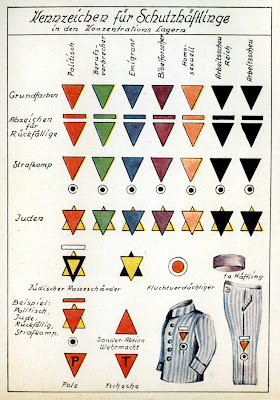
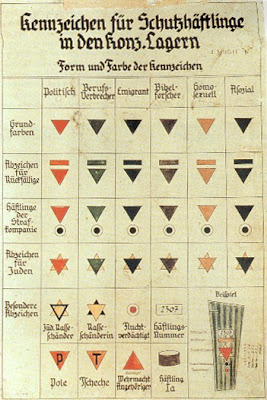
The Nazis used at least twelve distinct symbols in concentration camps.  Here are two posters depicting them:

A chart of prisoner markings used in German concentration camps. The vertical categories list markings for the following types of prisoners: political, professional criminal, emigrant, Bible Students (as Jehovah's Witnesses were then known as), homosexual, Germans shy of work, and other nationalities shy of work. The horizontal categories begin with the basic colors, and then show those for repeat offenders, prisoners in Strafkompanie, Jews, Jews who have violated racial laws by having sexual relations with Aryans, and Aryans who violated racial laws by having sexual relations with Jews. In the lower left corner, P is for Poles and T for Czechs (German: Tscheche). The remaining symbols give examples of marking patterns.


A chart of prisoner markings used in German concentration camps. The vertical categories list markings for the following types of prisoners: political, professional criminal, emigrant, Bible Students (as Jehovah's Witnesses were then known as), homosexual, Germans shy of work, and other nationalities shy of work. The horizontal categories begin with the basic colors, and then show those for repeat offenders, prisoners in Strafkompanie, Jews, Jews who have violated racial laws by having sexual relations with Aryans, and Aryans who violated racial laws by having sexual relations with Jews. In the lower left corner, P is for Poles and T for Czechs (German: Tscheche). The remaining symbols give examples of marking patterns.
Photos of Nazi concentration camp charts of prisoner markings public domain; source, Wikimedia; second photo by US Holocaust Memorial Museum.

    For more information, I encourage you to see the Wikipedia entries on:

    Nazi concentration camp badges at
    http://en.wikipedia.org/wiki/Nazi_concentration_camp_badges and

    Holocaust victims at
    http://en.wikipedia.org/wiki/Holocaust_victims 

    Monday, April 16, 2012

    Stalking in real life and on-line: National Stalking Awareness Day

    Wednesday, April 18th is National Stalking Awareness Day in Scotland, Wales, and England (http://www.scotlandagainststalking.com/node/67). 

    I want to talk a little bit about what stalking is, and a little in particular about cyber-stalking/virtual stalking, and why it carries real-world dangers. 

    What is stalking?  

    According to Action Scotland Against Stalking (ASAS), stalking includes "unwanted intrusions and communications," "following, loitering nearby, maintaining surveillance, and sending unwanted gifts or messages" (http://www.scotlandagainststalking.com/node/64).

    It's very, very easy to pretend that this sort of behavior is irritating and upsetting, but not really dangerous.

    However, over and over, law enforcement, advocates, and victims have seen that this behavior escalates over time, and too often culminates in assault (physical and/or sexual) or murder (ibid).

    Stalking is dangerous.  

    The key point is attention that is unwanted, unwelcome, intrusive, repeated, persistent, causing anxiety, causing fear or anger.

    It does not matter if the stalker is male or female.  It does not matter if they're a complete stranger, someone you know vaguely, someone you know well, a co-worker or former co-worker, a former family member, or someone you were once very close to but ended a relationship or friendship with. 

    If someone is stalking you, or you think someone might be stalking you but you're not sure, both ASAS and the National Stalking Helpine have on-line resources to help you assess the situation as well as to take steps to increase your safety.
    Again, they repeat that even if the situation has not become violent, it still causes harm and decreases the victim's quality of life. 

    If someone is stalking you, it's all too easy too feel isolated and ashamed.

    It's important to remember that it is not your fault. 

    Cyber-stalking

    Cyber-stalking may take place anywhere in the on-line world: email, websites, social networking, mobile phones, texts, etc.  Hand-in-hand with this is digitally-assisted stalking, with yet other tech aspects such as GPS.

    According to the National Stalking Helpline (http://www.stalkinghelpline.org/faq/about-stalking/) and Action Scotland Against Stalking (http://www.scotlandagainststalking.com/cyberstalking), cyber-stalking, although it takes place on-line, is much like "traditional" stalking and is essentially an extension of it.

    Why is cyber-stalking dangerous if it takes place virtually?

    Cyber-stalking, just like "traditional" stalking, escalates -- and just like with "traditional" stalking, it can escalate into physical violence, including death.

    Unwanted attention on-line can be even harder to take seriously than unwanted attention in the "real," physical world -- but it can be just as dangerous.

    Also, it's not hard for a cyber-stalker to figure out where the person they're stalking is in real life if that person adds specific locations to their blog posts; if they check in on social networking apps and have their privacy set so anyone can see where they are; or if the cyber-stalker is making a point of friending on social networks as many of the victim's friends as possible, etc. 

    Both NSH and ASAS offer cyber-safety tips at their websites.

    Cyber-stalking and women on-line

    Part of why I'm bringing this up is because many women in particular are targets of cyber-stalking -- especially women bloggers -- because we are women.

    As Kate Harding points out:

    Being viciously, persistently attacked for the crime of Writing While Female is something practically everyone with an opinion on the matter regards as par for the course–regardless of whether they believe that fact is outrageous and deplorable or merely, you know, the way the cookie crumbles.

    (http://kateharding.net/2007/04/14/on-being-a-no-name-blogger-using-her-real-name/)

    It's bad enough being attacked on-line for no other reason than being female.  But there is ample evidence these attacks then spill over into real life.  For some high-profile examples, witness what has happened to Kathy Sierra and Rebecca Watson both on-line and in real life.  (Rather than going into details here, I suggest you search for "Kathy Sierra Geek Feminism" and/or "Rebecca Watson Privilege Delusion" for more information.) 

    Less high-profile incidents happen to the rest of us when we're stalked in cyber-space and in real life.  Every day.   

    How do I know how seriously to take this?  or, Okay, I'm taking this seriously, but how do I talk to other people about it?  

    If you're having a hard time figuring out how seriously to take someone's persistent unwanted attention, or if you're taking it seriously but having a hard time talking to other people about it or getting other people to take it seriously, here are two helpful risk-identification tools by Laura Richards (http://laurarichards.co.uk/):


    I have found both very useful in assessing my own situation.

    No, you're not alone

    If you're being stalked, if someone is stalking you, you're not alone.  And it's very important to reach out to other people and get both support and help.  This can be very hard -- I know.  But as with any other kind of violence against women, it's that much more important for women who are being stalked to reach through the isolation.  The first person you reach out to might not be able to help you or be inclined to take you seriously.  The second person might not.  But you're still not alone, and it's still important to keep asking for help until you do get it.

    Resources in the US

    Since all the resources I've cited so far have been in the UK, here are some that are specific to the US:

    Thursday, April 12, 2012

    A question about "Pagan" Quaker process

    There's been some interesting discussion recently on the QuakerPagans email discussion list -- along the lines of, since early Friends came to/developed Quaker worship through Christian scripture (and through specific passages in Christian scripture), do Pagan Friends approach Meeting for Worship, and Meeting for Worship with Attention to Business, in an essentially different way?  If so, how?  (And how would one explain any difference, or lack of difference, to Christian Friends?)

    What I'm sharing here is expanded from an email I wrote to that list, so it's a little bit taken out of context, and sort of me thinking out loud; but I wanted to share it anyway.

    Like many modern-day Friends, I came to Friends through experience, rather than through reading Hebrew or Christian scriptures (although I was well-read in both, long before I came to Quakerism).  My participation in Meeting for Worship, and Meeting for Worship with Attention to Business, is rooted most in my direct experience of That-Which-Is-Sacred, and less in written words -- in experience, not in theory, and not in anyone else's recording of their experience (although I very much appreciate attempts to put experience into words). 

    I started coming to Meeting for Worship because I had a leading to come.  It's true that I initially thought that at worst, I'd get an hour of communal meditation out of it, but notice, even at the beginning, I knew that would be "at worst." 

    It's not Hebrew or Christian scriptures ("the Bible") that speaks to Christian Friends in worship -- it's the Divine Presence. 

    Why would I, as a Pagan Friend, not expect That-Which-Is-Sacred to speak to me/us directly in Meeting for Worship, whether "regular" worship or worship for business -- ? 

    I don't pretend to have all the theaological answers about which Gods/Divine Spirits are moving through us and speaking to us in worship.  In general, it doesn't much bother me if we're experiencing different Gods, unless people start getting monotheist exclusivist about it (or, try to tell me they're all the same God).  I can accept that there is some unifying spark, some unifying something which I don't fully understand; and that also works for me as a non-theist as well as a Pagan.

    To me, the bottom line is that Quakerism is bigger than Christianity.  Quaker practice is bigger than Jesus and Yhwh.  It's not limited to the God/s of Christianity.  Quaker practice can be informed by Jesus, Yhwh, Brigid, Herne, Cernunnos, Morgan, Athena, Demeter, Hecate, Cerridwen, Maiden, Mother, Crone, Air, Fire, Water, Earth, Spirit, many others, no god at all.

    That's how powerful it is. 

    And that's how Friends of differing theaologies can worship, and do Quaker business, together, in love and trust, asking how we're led. 

    At least, that's been my experience. 

    Of Quaker worship, and Quaker process, at its best, most powerful, most amazing, most magical, and most transformative.