Friday, April 27, 2012

Epistle from the 6th World Conference of Friends

This moved me.  - sm

from http://saltandlight2012.org/6th-world-conference-friends-epistle.

24 April 2012

To Friends Everywhere,

We greet you amid the beauty of the Rift Valley, surrounded by the welcoming embrace of Kenyan Friends.  From April 17 to 25, 2012 close to 850 men and women from all the streams of Friends, coming from 112 yearly meetings and groups in 51 countries have gathered at Kabarak University near Nakuru to consider the theme "Being Salt and Light: Friends Living the Kingdom of God in a Broken World."

The colours, songs, movements, rich diversity and joyful spirit of Friends here gathered have inspired and uplifted us all.  We have heard Friends from around the world, including several young, prophetic voices, speak on the theme. They gave a wide variety of interpretations of salt and light in a biblical context and also in how we can apply its meaning to life in our world today.

The call that brought us together was to be salt and light as we live out the Kingdom of God.  We received this call with a real sense of urgency in these times of natural disasters, violence, global change, and unequal access to basic needs.  We have been reminded that we are sometimes too preoccupied with being heavenly to be useful on Earth. We see this as a challenge to not detach ourselves from the wider society in hope that this will bring us closer to God. Rather, we need to be present and engaged in our communities, while remaining attentive to the Still, Small Voice, in order to allow the Spirit to work through us.

'The Religious Society of Friends--the Friends Church-- is about nothing if it is not about transformation' in the words of one of our speakers.  As Friends we feel called to try to return to the conviction and simple faith of our Quaker ancestors and their transformed lives, so that we may once again become a prophetic people, speaking to God's purposes in these times.

We first have to look inward, both as individuals and as a religious society.  Can we end our internal strife? Can we reach out in love to one another as Jesus commanded? We may not understand liberal/evangelical/programmed/unprogrammed Friends but we are Friends. The diversity of Friends at this conference has provided us with an opportunity to live out our testimonies to equality and truth. Our ability to do so has been put to the test. We found ourselves reluctant to go beyond polite acceptance and avoidance of difference. We are not united in all of our attitudes and beliefs, yet we choose to come together to listen, to share, and to hear things we may find uncomfortable and upsetting. As we choose to seek connection in the midst of our differences, we witness the power of God to bless and heal. We may not always understand each other fully, but we are united in our yearning for transformation. We are united in God.

We live in a broken world. We were moved to realise that so many of us here carry a sense of grief, loss, failure or hurt. We were forced to recognise the brokenness in us and in our Religious Society. A speaker challenged us to consider that brokenness may also be opportunity. We are uncomfortable with feeling brokenness and seeing it around us, yet from it we gain strength, empathy and compassion. Rather than trying to heal our brokenness as quickly as possible, we challenge ourselves - and Friends everywhere - to consider what God's plan could be for a hurting individual, and for a hurting community.

We know that the Kingdom is come and coming. We pray that we may experience the Kingdom of God within ourselves here and now, so that we may live it more fully in transforming this world. In this we anticipate the everlasting Kingdom, in which the world will be made whole.

Here in Kenya, we remember the post-election violence that shook this nation in 2008, and the courageous stance taken by our brothers and sisters. We invite all Friends to join us in prayer for Kenyan Friends who are working even now for the prevention of conflict, and for their whole nation as their elections approach. We pray also for all people facing conflict and violence in the world.

Early on in our time together, we were asked the same question that God asked Elijah on Sinai: "What are you doing here?" In the latter half of the conference we have considered many queries that have come out of our work together in small groups. Each of these queries asks, in one way or another, "What will you do after you leave here?" We bear these queries with us, as they are for all Friends to discern how God is leading.

The inward voice of Christ Jesus is what will answer these questions for us. May we be faithful in listening to that voice once we have returned from this gathering.  As Christ leads all of us, we can become the salt of the Earth and the light of our broken world.
 

Wednesday, April 18, 2012

Yom HaShoah

[Visual content warning, near the end, for concentration camp survivors.]

International Holocaust Remembrance Day, instituted by the United Nations General Assembly, is on the 27th of January (http://en.wikipedia.org/wiki/International_Holocaust_Remembrance_Day).

Today is Yom HaShoah, Holocaust Remembrance Day, in the Jewish calendar.

But I remind you, my friends, that the Holocaust killed not only Jews. That of the 11 million people killed in the Nazi concentration camps, 6 million were Jews, and 5 million were:
  • political prisoners
  • leftists
  • liberals
  • communists
  • pacifists
  • conscription resisters
  • deserters
  • spies
  • prisoners of war
  • unionists
  • royalists
  • social democrats
  • socialists
  • Freemasons
  • anarchists
  • convicts
  • forced laborers
  • immigrants
  • gay and bisexual men
  • lesbian and bisexual women
  • people of color
  • Jehovah's witnesses
  • Roma (gypsies)
  • people with mental illness
  • people with disabilities
  • alcoholics and addicts
  • beggars
  • homeless people
  • sex workers
  • "race defilers" (people who had sex with the "wrong" opposite-sex people)
  • those who couldn't work
  • racial, ethnic, religious, and cultural minorities
  • and more.

You and me.

Never again. Never forget.

I was privileged to know a number of Holocaust survivors growing up.

I honor them, those who are still living and the memory of those who have died.

------------

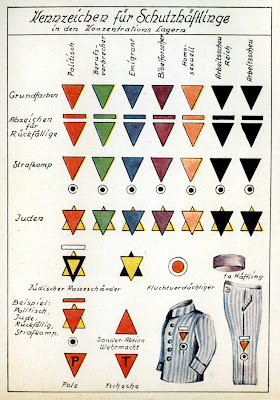
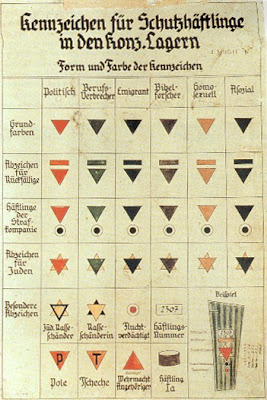
The Nazis used at least twelve distinct symbols in concentration camps.  Here are two posters depicting them:

A chart of prisoner markings used in German concentration camps. The vertical categories list markings for the following types of prisoners: political, professional criminal, emigrant, Bible Students (as Jehovah's Witnesses were then known as), homosexual, Germans shy of work, and other nationalities shy of work. The horizontal categories begin with the basic colors, and then show those for repeat offenders, prisoners in Strafkompanie, Jews, Jews who have violated racial laws by having sexual relations with Aryans, and Aryans who violated racial laws by having sexual relations with Jews. In the lower left corner, P is for Poles and T for Czechs (German: Tscheche). The remaining symbols give examples of marking patterns.


A chart of prisoner markings used in German concentration camps. The vertical categories list markings for the following types of prisoners: political, professional criminal, emigrant, Bible Students (as Jehovah's Witnesses were then known as), homosexual, Germans shy of work, and other nationalities shy of work. The horizontal categories begin with the basic colors, and then show those for repeat offenders, prisoners in Strafkompanie, Jews, Jews who have violated racial laws by having sexual relations with Aryans, and Aryans who violated racial laws by having sexual relations with Jews. In the lower left corner, P is for Poles and T for Czechs (German: Tscheche). The remaining symbols give examples of marking patterns.
Photos of Nazi concentration camp charts of prisoner markings public domain; source, Wikimedia; second photo by US Holocaust Memorial Museum.

    For more information, I encourage you to see the Wikipedia entries on:

    Nazi concentration camp badges at
    http://en.wikipedia.org/wiki/Nazi_concentration_camp_badges and

    Holocaust victims at
    http://en.wikipedia.org/wiki/Holocaust_victims 

    Monday, April 16, 2012

    Stalking in real life and on-line: National Stalking Awareness Day

    Wednesday, April 18th is National Stalking Awareness Day in Scotland, Wales, and England (http://www.scotlandagainststalking.com/node/67). 

    I want to talk a little bit about what stalking is, and a little in particular about cyber-stalking/virtual stalking, and why it carries real-world dangers. 

    What is stalking?  

    According to Action Scotland Against Stalking (ASAS), stalking includes "unwanted intrusions and communications," "following, loitering nearby, maintaining surveillance, and sending unwanted gifts or messages" (http://www.scotlandagainststalking.com/node/64).

    It's very, very easy to pretend that this sort of behavior is irritating and upsetting, but not really dangerous.

    However, over and over, law enforcement, advocates, and victims have seen that this behavior escalates over time, and too often culminates in assault (physical and/or sexual) or murder (ibid).

    Stalking is dangerous.  

    The key point is attention that is unwanted, unwelcome, intrusive, repeated, persistent, causing anxiety, causing fear or anger.

    It does not matter if the stalker is male or female.  It does not matter if they're a complete stranger, someone you know vaguely, someone you know well, a co-worker or former co-worker, a former family member, or someone you were once very close to but ended a relationship or friendship with. 

    If someone is stalking you, or you think someone might be stalking you but you're not sure, both ASAS and the National Stalking Helpine have on-line resources to help you assess the situation as well as to take steps to increase your safety.
    Again, they repeat that even if the situation has not become violent, it still causes harm and decreases the victim's quality of life. 

    If someone is stalking you, it's all too easy too feel isolated and ashamed.

    It's important to remember that it is not your fault. 

    Cyber-stalking

    Cyber-stalking may take place anywhere in the on-line world: email, websites, social networking, mobile phones, texts, etc.  Hand-in-hand with this is digitally-assisted stalking, with yet other tech aspects such as GPS.

    According to the National Stalking Helpline (http://www.stalkinghelpline.org/faq/about-stalking/) and Action Scotland Against Stalking (http://www.scotlandagainststalking.com/cyberstalking), cyber-stalking, although it takes place on-line, is much like "traditional" stalking and is essentially an extension of it.

    Why is cyber-stalking dangerous if it takes place virtually?

    Cyber-stalking, just like "traditional" stalking, escalates -- and just like with "traditional" stalking, it can escalate into physical violence, including death.

    Unwanted attention on-line can be even harder to take seriously than unwanted attention in the "real," physical world -- but it can be just as dangerous.

    Also, it's not hard for a cyber-stalker to figure out where the person they're stalking is in real life if that person adds specific locations to their blog posts; if they check in on social networking apps and have their privacy set so anyone can see where they are; or if the cyber-stalker is making a point of friending on social networks as many of the victim's friends as possible, etc. 

    Both NSH and ASAS offer cyber-safety tips at their websites.

    Cyber-stalking and women on-line

    Part of why I'm bringing this up is because many women in particular are targets of cyber-stalking -- especially women bloggers -- because we are women.

    As Kate Harding points out:

    Being viciously, persistently attacked for the crime of Writing While Female is something practically everyone with an opinion on the matter regards as par for the course–regardless of whether they believe that fact is outrageous and deplorable or merely, you know, the way the cookie crumbles.

    (http://kateharding.net/2007/04/14/on-being-a-no-name-blogger-using-her-real-name/)

    It's bad enough being attacked on-line for no other reason than being female.  But there is ample evidence these attacks then spill over into real life.  For some high-profile examples, witness what has happened to Kathy Sierra and Rebecca Watson both on-line and in real life.  (Rather than going into details here, I suggest you search for "Kathy Sierra Geek Feminism" and/or "Rebecca Watson Privilege Delusion" for more information.) 

    Less high-profile incidents happen to the rest of us when we're stalked in cyber-space and in real life.  Every day.   

    How do I know how seriously to take this?  or, Okay, I'm taking this seriously, but how do I talk to other people about it?  

    If you're having a hard time figuring out how seriously to take someone's persistent unwanted attention, or if you're taking it seriously but having a hard time talking to other people about it or getting other people to take it seriously, here are two helpful risk-identification tools by Laura Richards (http://laurarichards.co.uk/):


    I have found both very useful in assessing my own situation.

    No, you're not alone

    If you're being stalked, if someone is stalking you, you're not alone.  And it's very important to reach out to other people and get both support and help.  This can be very hard -- I know.  But as with any other kind of violence against women, it's that much more important for women who are being stalked to reach through the isolation.  The first person you reach out to might not be able to help you or be inclined to take you seriously.  The second person might not.  But you're still not alone, and it's still important to keep asking for help until you do get it.

    Resources in the US

    Since all the resources I've cited so far have been in the UK, here are some that are specific to the US:

    Thursday, April 12, 2012

    A question about "Pagan" Quaker process

    There's been some interesting discussion recently on the QuakerPagans email discussion list -- along the lines of, since early Friends came to/developed Quaker worship through Christian scripture (and through specific passages in Christian scripture), do Pagan Friends approach Meeting for Worship, and Meeting for Worship with Attention to Business, in an essentially different way?  If so, how?  (And how would one explain any difference, or lack of difference, to Christian Friends?)

    What I'm sharing here is expanded from an email I wrote to that list, so it's a little bit taken out of context, and sort of me thinking out loud; but I wanted to share it anyway.

    Like many modern-day Friends, I came to Friends through experience, rather than through reading Hebrew or Christian scriptures (although I was well-read in both, long before I came to Quakerism).  My participation in Meeting for Worship, and Meeting for Worship with Attention to Business, is rooted most in my direct experience of That-Which-Is-Sacred, and less in written words -- in experience, not in theory, and not in anyone else's recording of their experience (although I very much appreciate attempts to put experience into words). 

    I started coming to Meeting for Worship because I had a leading to come.  It's true that I initially thought that at worst, I'd get an hour of communal meditation out of it, but notice, even at the beginning, I knew that would be "at worst." 

    It's not Hebrew or Christian scriptures ("the Bible") that speaks to Christian Friends in worship -- it's the Divine Presence. 

    Why would I, as a Pagan Friend, not expect That-Which-Is-Sacred to speak to me/us directly in Meeting for Worship, whether "regular" worship or worship for business -- ? 

    I don't pretend to have all the theaological answers about which Gods/Divine Spirits are moving through us and speaking to us in worship.  In general, it doesn't much bother me if we're experiencing different Gods, unless people start getting monotheist exclusivist about it (or, try to tell me they're all the same God).  I can accept that there is some unifying spark, some unifying something which I don't fully understand; and that also works for me as a non-theist as well as a Pagan.

    To me, the bottom line is that Quakerism is bigger than Christianity.  Quaker practice is bigger than Jesus and Yhwh.  It's not limited to the God/s of Christianity.  Quaker practice can be informed by Jesus, Yhwh, Brigid, Herne, Cernunnos, Morgan, Athena, Demeter, Hecate, Cerridwen, Maiden, Mother, Crone, Air, Fire, Water, Earth, Spirit, many others, no god at all.

    That's how powerful it is. 

    And that's how Friends of differing theaologies can worship, and do Quaker business, together, in love and trust, asking how we're led. 

    At least, that's been my experience. 

    Of Quaker worship, and Quaker process, at its best, most powerful, most amazing, most magical, and most transformative.

    Sunday, March 25, 2012

    Spring Equinox: shedding the bonds of winter

    Last week in Meeting for Worship, I had Suzanne Sterling's chant "Inanna" running through my head. 

    Why?, I wondered.  That's very much a fall tune.  And realized, well, yes, that was in my head at Fall Equinox.  And here we are, half the year later, half-way 'round, at Spring Equinox. 

    These queries came to me:
    • What wholeness have you found underground?  In winter?  (Take a moment before going on to the next query.)
    • What truths?  (Take a moment before going on to the next query.)
    • What bonds of winter, of the underworld, are you shedding as you emerge into spring?  Into the sunlight?  (Take a moment.)

    The music that came to me next was another song/chant I learned from Reclaiming, "Snake Woman":
    Snake woman, shedding Her skin
    Snake woman, shedding Her skin
    Shedding, shedding, shedding Her skin
    Shedding, shedding, shedding Her skin...

    Blossom woman, opening wide...

    And some of the Spring parts from "Kore Evohe," by Sabine Becker and John Schrag*:
    Kore, bright and wild, Summer's blessed child
    Spring incarnate and joy in bloom...
    Life uprising from Winter's tomb
    Kore, evohe!  Kore, evohe!  Kore, evohe!

    Welcome, Spring!


    Wednesday, March 7, 2012

    Recommended article: Michelle Francl-Donnay's "Custody of the eyes"

    From Michelle Francl-Donnay's "Custody of the eyes":

    Pedestrians in a city practice an unsympathetic custody of the eyes. Do not acknowledge with even the flick of an eye what — who — stands on corners, crouches over steam vents or sits plastered against the walls of buildings. Do not accord the pleas for food or for money a space in your conversation, not even for a single beat. It’s safer, they say. So we walk with eyes locked straight ahead, doggedly intent on our conversations.

    Francl-Donnay violated that rule. 

    She connected with someone. 

    He thanked me and with not even a hint of rancor remarked, “No one ever looks at me, you know..."

    Read the whole article here: http://ignatianlife.org/custody-of-the-eyes/

    How do we connect with That of God, with the Goddess-within, the God-within, people we meet in this way?

    How do we recognize each others' humanity?

    Monday, March 5, 2012

    Some Advices and Queries active in my life right now

    There's a concern I've been laboring under for a number of years in the Society of Friends.  It's come up afresh over the last few months, and it socked me right in the stomach a little over a week ago, what's more, very personally and locally.

    This First Day, due to uncontrollable circumstances at home -- cat-related; I need say no more, and you may laugh, as long as it's sympathetic -- I arrived late at Meeting for Worship.  I joined Beloved Wife, who'd actually gone to Meeting ahead of me and gotten there early.

    I gratefully settled into worship next to her in the bright sunshine. 

    Our Meeting tends to have numerous copies of both Britain Yearly Meeting's Faith and Practice and the Advices and Queries, a small booklet separated out from F&P, scattered throughout the Meeting room.   

    Although its immediacy had faded somewhat in my daily life, my concern was very much present in my worship.

    I found myself looking through Advices and Queries for something to help deepen my worship around it.  Three of them stayed with me, and after a while I found my heart pounding in what might be that tell-tale way.  (All together with me, now: Oh, please, no, not after coming in late...)

    I ended up reading them aloud. 

    Which led to even deeper nuances for me in each of them.  Hmmmmmmm.

    (If you'd like to hear them read aloud, click on the "Out loud" link after each one below, then on the video.)  (I admit I do not sound like either of these readers.)

    16. Do you welcome the diversity of culture, language and expressions of faith in our yearly meeting and in the world community of Friends? Seek to increase your understanding and to gain from this rich heritage and wide range of spiritual insights. Uphold your own and other yearly meetings in your prayers.  (Out loud.)

    17. Do you respect that of God in everyone though it may be expressed in unfamiliar ways or be difficult to discern? Each of us has a particular experience of God and each must find the way to be true to it. When words are strange or disturbing to you, try to sense where they come from and what has nourished the lives of others. Listen patiently and seek the truth which other people's opinions may contain for you. Avoid hurtful criticism and provocative language. Do not allow the strength of your convictions to betray you into making statements or allegations that are unfair or untrue. Think it possible that you may be mistaken.  (Out loud.)

    38. If pressure is brought upon you to lower your standard of integrity, are you prepared to resist it? Our responsibilities to God and our neighbour may involve us in taking unpopular stands. Do not let the desire to be sociable, or the fear of seeming peculiar, determine your decisions.  (Out loud.)

    Just after worship, I had several lovely conversations with Friends unrelated to my vocal ministry, one difficult but lovely conversation related to my vocal ministry -- and to gossip -- and one hard but good conversation about local issues and my concern. 

    To my surprise, none of Britain Yearly Meeting's Advices and Queries seems to address gossip. 

    So today I went looking in North Pacific Yearly Meeting's Faith and Practice (my home Yearly Meeting), and searched the Advices and Queries to see what I might find there:

    Our need for love and care, and our response to this need in others, make up a rich part of our lives. In an exchange truly grounded in love, each of us is both giver and receiver, ready to help and accept help. Neither pride nor fear keeps us from the unconditional love and care of God manifested through others. Let neither comfort nor self-centeredness blind us to need of others.

    We listen to one another with openness of heart and in good faith, aware that greater wisdom than our own is required to meet our human needs. We lift up our hearts to the Source of all wisdom and power.

    Are we charitable with each other? How careful are we of the reputation of others? Do we avoid hurtful criticism and gossip?


    So, I leave you to ponder these Advices and Queries.

    The Goddess, the Gods, the Spirit, not sure what the best word is, have been active in my life lately.  Things have been both challenging, and good; very both/and.  (I really don't want to give the impression I've been thoroughly miserable lately; far from it.  But well-challenged and kind of tender, yes.) 

    I am sustained by the support of friends and Friends, and by good Quaker process.  Blessed be.

    Wednesday, February 29, 2012

    Brigid was here

    Brigid was here.  There are many ways I can tell.

    I can tell because the days are so much longer, so quickly. 

    I can tell because the sun comes up earlier.  

    I can tell because I hear different birdsongs now. 

    I can tell because the sun is in different places throughout the day now than it was at Winter Solstice.  When the cats lounge in the sun in our south-facing main room, they sometimes sit on the floor now, instead of always on the table.  When I'm working at my computer, the sun hits different places in my office than it did six weeks ago.  At Meeting for Worship, the places where one should sit if one does or does not want sun in one's eyes, or on the back of one's head, has shifted. 

    The sun is higher in the sky, and that seems to be changing every day. This is dramatically noticeable. 

    I can tell because when I'm working at my computer and I need to turn on the office lights, it's later in the day. 

    I can tell from the different things that happened at our Brigid-inspired potluck dinner party a few weeks ago: creativity, community, fun, fast friendship between a child who expected to be bored and a normally-aloof cat, lots of laughter, some silliness, learning to make Brigid's crosses (there was some swearing, a true feeling of accomplishment, and some just plain fun involved), delightful food (a beetroot and sheeps'-milk feta torte, sheeps'-milk being traditional for Imbolc/Brigid; chili with Boston brown bread (aka cornbread with corn and rye flours); salad; apple pie and apple crumble and stewed apples; lots of chocolate...).

    Brigid was here.

    Tuesday, February 14, 2012

    Accessibility, Handwork, and Ministry in Meeting for Worship

    This article first appeared in the January, 2012 issue of Friends Journal. - sm

    Accessibility, Handwork, and Ministry in Meeting for Worship
    Staśa Morgan-Appel

    In the summer of 2000, I was in a car accident with multiple impacts. I walked away from it, but for months afterward, I couldn’t sit still for more than 20 minutes because of the pain. This was a problem in many areas of my life—work, home, volunteering, meeting for worship.

    At the time, I was part of a large meeting which met in a large meetinghouse, and I could usually find a seat on the end of a bench, toward the back of the room. I could lie down on the floor when I needed to; I could get up and go into the back entry way, which we rarely used, and pace when I needed to, then come hover in the doorway to listen to any vocal ministry that was offered. The people in my meeting knew about the accident and seemed to understand the reasons for my odd behavior. It didn’t seem to bother anyone, at least. And as I healed, I was able to sit through more and more of worship again, eventually the full hour.

    A few years later, I sustained a severe ankle injury. I was in constant pain: I couldn’t sit, stand, lie down, or walk without pain. Again, this affected every area of my life, and again, I found it very hard to settle into meeting for worship. Pacing in the back of the room wasn’t an option this time. For the first six months after the injury, my ankle was usually taped, so I could shift and wiggle easily in my seat when the pain became too great or too distracting. My usual seat-mate, my spouse, was sympathetic, although I’m sure it did not help the quality of her worship any.

    But after six months, when the pain continued, my doctor placed my ankle and leg in a series of casts and braces—too big to make wiggling possible without loud thumps against the benches or being quite noticeable visually. The Worship and Ministry committee, on which my wife was serving, had asked its members to sit on the facing benches even when they didn’t have care of meeting. My squirming would now be even more obvious. I tried sitting on the floor in front of the first facing bench, where my wiggling was less noisy, but I felt that it was still very visible and distracting.

    Worst of all for me was the loss of worship. I was not able to take part in communal worship because meeting had become an exercise in endurance through pain, not one of worship and not one of community. There are practices that are about reaching spiritual communion through physical discomfort or even pain, and I have experience in some of them. But meeting for worship is not, and should not be, such an experience.

    What to do? There were many options. None of them was worship.

    That fall, my F/friend Russell died. I have an active crochet ministry, and I had a very clear leading to make a comfort wrap or throw for his devastated husband. I worked on it mostly during meeting for worship with attention to business, announcements at the rise of meeting, committee meetings, and the like.

    One day during meeting for worship when I was in a lot of pain and just couldn’t settle, I took my bag, went to the back corner of the room, and, hidden from view, sat on the floor, crocheting his throw while holding him in the Light, in worship.

    It worked. I was able to settle into, and remain in, worship with my meeting.

    The handwork distracted me from the pain. Unlike reading, it did not require the intellectual portion of my brain, and so I was able to stay in worship as I’m unable to do always when reading. Because it was ministry, the handwork was enhanced by my being in worship and by my being in worship with my spiritual community. Most of all, handwork was a spiritual tool that made meeting for worship accessible to me in spite of my disability. It was an accessibility aid and a spiritual tool.

    Years passed and I didn’t think much about it. My spouse and I had both undertaken mid-life career changes, and we moved several times for her to go to graduate school and to work in temporary positions. We were part of several other meetings.

    I became a member of a meeting that was open to diverse ways of making worship accessible to those having difficulty with mobility, neuro-atypicality, vision, hearing, and mental illness. In our meeting, we often balance behavior in meeting for worship that helps some people center but distracts others. As we participated in several meetings, I discovered that some of these ways of making worship accessible irritated me hugely...until I knew why they were being done.

    This bothers me: Why should my knowing make a difference? Why would I assume that someone is being irritating on purpose, that someone is not participating fully? Why wouldn’t I assume that what they are doing—whatever it is: reading, handwork, writing, quiet play with hand-puppets, Sudoku—allows them to be fully present in meeting for worship? And yet, once I know the story (someone is neuro-atypical; someone is a young person who prefers meeting for worship to First-day school; someone is in chronic pain; someone just had news of a loved one in the ICU), my irritation vanishes. It makes sense and it ceases to be a problem for me. This difference in my own attitudes bothers me.

    A few years ago (we had moved again and were sojourning in a different meeting), I started experiencing a very unpleasant flare-up of a chronic neurological condition. One of the treatments made it likely that I would become fairly sleepy, unless I had direct sensory stimulation. To my horror, I found myself regularly falling asleep in meeting for worship.
    I’m told occasional napping during meeting can be very worshipful, and I have often joked about hosting “meeting for worship with attention to napping.” But my chemically-and neurologically-induced experience was definitely not worshipful. It was awful.

    So I was experiencing the loss of worship itself and of worship in community—yet again, at a time when I very much needed it. I didn’t want to read. I didn’t want to get up and leave meeting when I started to fall asleep. And I didn’t want to sleep in meeting. I wanted to worship—in community. On top of that, the meetinghouse where we were sojourning was quite small, and anyone doing any of those things, reading, leaving, sleeping, would be very obvious.

    Finally, I thought about trying handwork again. People were used to seeing me crochet in meeting for worship with attention to business. We had a ramp for those who used wheelchairs, and we were engaged in discussions about other kinds of accessibility. People might understand. I explained the situation to the Ministry and Counsel committee and received a great deal of support.

    Again, handwork helped me stay present in worship in community. It worked as both an accessibility device and a spiritual tool. Without handwork, worship would have been literally inaccessible to me. I would have had to leave the room; I would not have been able to be in meeting for worship.

    This may be a novel idea: things we don’t usually consider to be acceptable behavior in meeting for worship can be spiritual tools that are accessibility aids. This idea also gives us the beginnings of some new ways to answer the question: how do we make our meetings more accessible to people with different kinds of disabilities and accessibility needs?

    Here are some things I have learned to ask myself (and for others to ask themselves) when another person is doing something that irritates us in meeting for worship:
    • Could there be a good reason that the person is doing this?
    • Could that reason have something to do with accessibility and a hidden disability?
    • Could what he/she is doing actually be a form of ministry?

    Staśa Morgan-Appel is a member of University Friends Meeting in Seattle, Wash., attending Central Edinburgh Quaker Meeting in Scotland. She has a letter of introduction and religious service from University Friends Meeting, with a ministry focusing on spiritual nurture with individuals and groups. She is a middling but avid crocheter and blogs at http://aquakerwitch.blogspot.com.

    © 2012 Friends Publishing Corporation. Reprinted with permission. To subscribe: www.friendsjournal.org

    Friday, February 10, 2012

    Two wonderful videos from UUI's Winter Solstice Celebration

    Ever wonder what those Winter Solstice Celebrations based on A Winter Solstice Singing Ritual that I'm always talking about are like?  

    Well, I can give you a little window into part of one of them: here are two videos from the 2011 Winter Solstice Celebration at the Unitarian Universalist Church of Indianapolis!

    The first video includes parts of "Imani," by Rachael A. K. Hazen, and "We've Got the Power," a traditional song from South Africa:


    The second video includes the grounding and centering from the Narration, co-written by Julie Forest Middleton and Stasa Morgan-Appel:


    Excerpted from a presentation of A Winter Solstice Singing Ritual, (c) 2002 Julie Forest Middleton and Stasa Morgan-Appel.  For more information, click here.

    Enjoy!

    Tuesday, February 7, 2012

    In the velvet darkness, II: the rest of the weekend

    The third weekend of December -- the velvet night of the darkest time of the year -- was for me filled with light, laughter, absurdity, and magic.

    The magic of Winter Solstice

    That Saturday night was my first Winter Solstice Celebration in Edinburgh, which I posted about here.

    When it was over, and we had finished cleaning up, we caught a cab home.

    And such a cab ride it was. 

    Through the worm-hole

    We lugged our bags and baggage to the taxi stand across the street, climbed into the first taxi, and entered a worm-hole

    There was a stocking hung up behind us.  There were a neon tree and an electric wreath on the divider in front of us. 

    As we got underway, the cabbie told us "There's a treat for you in the stocking, if you've been good."  I did not have the courage to reach in there, but Co-Conspirator did, and found good chocolate candy, which she generously shared.

    The cabbie, having heard my American accent when we gave the address, asked where I was from; I said the US, he asked where, I explained, yada, yada.  Conversation ensued about how America has given the world some of the best music and musicians and recording artists, like Luther Vandross, you know, and...

    Would we like to hear him (the cabbie) sing?  It's something he learned from one of the greatest American artists...

    Sure!, we chorus.  (It's only a short cab ride, and we're punchy anyway.)  

    He puts on a karaoke CD (truly!), and starts singing Barry Manilow's "I Made It Through the Rain."

    !!!!!

    I'm in the middle, wedged between Co-Conspirator and Beloved Wife.  Co-Conspirator is clutching my shoulder; Beloved Wife is carefully not looking at or touching either of us (well, except for being wedged tightly together).

    This guy can actually sing, and sing well.  And he's clearly practiced and has good breath control.  (He even timed it well with the speed bumps!)  

    And here is where our accounts diverge.

    I think we're having a meaningful experience.  Sure, it's schmaltz!  But there's something really lovely and wonderful about it for all that.  Right? 

    Noooo.  Beloved Wife and Co-Conspirator are having a completely different experience of the schmaltz.

    (Or maybe it's treacle for them -- ?  That could be why.)

    So we get back to the flat, get everything inside, and --

    Collapse into gales of laughter. 

    None of us can quite believe it all, and we all think it's the most surreal thing ever.

    Co-Conspirator (who has a degree in a relevant field) decides it was a worm-hole.  There is just no other explanation.

    I decide we must have gone through New York City on our way from St. John's back to our side of town, because really, where else would this happen? Edinburgh??

    Eventually we have cups of her amazing peppermint tea and eat lots of dark chocolate digestive biscuits before she returns to her own nearby flat.  But we keep bursting into giggles.

    The 80s are back

    The next day, Beloved Wife and I went grocery shopping.

    There's a Clarks shoe store in the same shopping center as our nearest grocery store, and we had a little bit of time and I needed boots, so we decided to duck in.  Plus, they were having a big sale.

    I tried on some of what I needed, with Beloved Wife urging me away from plain weather-proof boots in hiking-boot styles, and towards trendy/dressy weather-proof boots.

    "You know, it didn't occur to me that I could get dressy winter boots.  No wonder I wasn't excited about those.  These are much nicer." 

    "No, no, you definitely need stylish boots."

    (I feel like somehow, over the years, our shoe conversations have flipped 180 degrees.  I think I definitely used to be the one with dressier shoes (and boots).  Now she is.  (Maybe it's the influence of Dr. Isis -- ?)) 

    They didn't have what I decided I wanted in my size, but I tried on some similar things. 

    And then Beloved Wife found these lovely black leather zip-up slightly-slouch ankle boots with a buckle and chain on sale for £30.  They would fit a hole in my wardrobe, but were not what I had gone into the store to buy, and therefore I couldn't buy them, right?  But they were so cute.  And Beloved Wife thought they looked fabulous (actually, she used a different word).  And they had them in my size, and they fit.  (I have hard-to-fit feet.)  And they were on sale.  And they were sensible, comfortable, walkable, and sexy.

    And they were giving me flashbacks to my adolescence.

    I tried them on and walked over to the mirror.  "I feel like I'm back in high school.  Only I'm finally trendy!" 

    The second (older) salesclerk looked at me and said, "Wow.  All you need are leg warmers!"

    At which point I -- yes, it's true -- I pulled up my jeans legs and pulled down my leg warmers.

    At which point she, Beloved Wife, and I collapsed into gales of laughter.

    The salesclerk who was helping us returned from the back with another boot in another size.  "What?"  I showed her.  "Oh, that's cute!" she said, smiling and nodding.

    Clearly of a generation which could not understand why it was hilarious rather than "cute." 

    I looked at the other salesclerk and asked, "Have you seen 'Flashdance'?"  She nodded.  I solemnly intoned, "I promise I no longer own any ripped sweatshirts."  She giggled. 

    I did buy the boots.  And they are totally awesome. And quite comfortable. 

    And you can't even tell they're 80s boots if I'm wearing them inside my jeans.

    Feuerzangenbowle

    Monday night, I went to a small work party/get-together with Beloved Wife, her work group, and some of their assorted family members.  In general, I enjoy her colleagues and their collective (and sometimes slightly warped) sense of humor.

    Our host had said in the email invitation, that because they were missing pieces from the set, there would "probably be no flaming tongs"... but it turned out we were treated to the German tradition of Feuerzangenbowle, or flaming punch, after all.  Here's a link to a video, but it does not completely capture the magic (in the spiritual sense or the geek or chemistry senses) of blue flaming rum and sugar dropping down into the punch bowl and running around til burned. 

    So we had light in the darkness, good-natured teasing, conversation, company, friendship, and lots of laughter on Monday, as well.

    And then Beloved Wife and I had a few quiet days to ourselves before spending the rest of the holidays with family.

    Blessings

    I hope your holidays were similarly blessed with magic, laughter, good companionship, friendship, family, love, chocolate, fire, unexpected blessings... and schmaltz.

    (Just in case, here's a little extra schmaltz for you.  I'm sorry he doesn't have a Scottish accent like our cab driver.)


    Thursday, February 2, 2012

    Poetry for Brigid: "Contradance" by Judith Laura

    Please check out this wonderful poem by Judith Laura!  There's also a great video following, from the weekly contra in Glen Echo, near DC, with the amazing Cis Hinkle calling and music by the fabulous Moving Violations.  (I have danced to Cis' calling, and she rocks.)

    Many of you may find Judith Laura's name familiar from her poem "Hear Our Great Mother," used with permission as the invocation to the Goddess in the Winter Solstice Celebration / A Winter Solstice Singing Ritual ("Hear our Great Mother, robed in midnight, around Whose head shine all the..."). 

    Enjoy!

    Poetry for Brigid: Maya Angelou reading "And Still I Rise"


    Wednesday, February 1, 2012

    In the velvet darkness I: The magic of Winter Solstice

    The third weekend of December -- the velvet night of the darkest time of the year -- was for me filled with light, laughter, absurdity, and magic. 

    The magic of Winter Solstice

    That Saturday night was my first Winter Solstice Celebration in Edinburgh.  As as I do pretty much every year -- even when I also do something else for Solstice, and even when I work with it by myself -- I worked with A Winter Solstice Singing RitualI did a community Celebration, as I often do.  And this year, it was completely different from any other year, as is often the case.

    I was not working with a choir this year, instead depending on... whomever was led to show up.  In the past when this has been the case, I've at least known ahead of time who was coming.  Not so this year.  I taught two music workshops ahead of time, both of which were lovely, but had small attendance, and then spent an evening singing with my Co-Conspirator, the F/friend who was my co-planner/publicity helper, going over music.  (Heh heh heh heh.  She subsequently turned up on my doorstep compulsively singing "Imani" and "We've Got the Power."  *happy cackle*)

    It turned out we would have four singers as anchors, including me.  Hmmmm.

    Other volunteers are also needed to make this happen: one Narrator, four Readers, some candle volunteers, a greeter, people to set up and break down...

    The week before, I had met with the person who'd agreed to be Narrator, someone from my Meeting here.  I was really looking forward to hearing her narrate; she has a beautiful reading voice, she was convinced this was going to be lovely, and she was looking forward to seeing it in reality.  Co-Conspirator and Beloved Wife had agreed to be Readers #1 and #3 and to help with set-up, and Beloved Wife had agreed to be the welcome person/staff the door.  We still needed Readers #2 and #4 as well as candle volunteers, and were going to ask people as they arrived.

    We felt pretty confident this would work.

    I had no idea who would show up.  I'd sent announcements to both the closest Quaker Meetings and to several local Pagan groups, had posted fliers in the businesses closest to the Hall we'd rented as well as several other crunchy-granola businesses and my library, had emailed friends, and had posted to Facebook and Witchvox, etc. -- all the usual.

    It was a big experiment, and I had layer of "Eeek!" in there somewhere, but mostly I felt a kind of flexible, happy expectation: I didn't know what would happen, but it was going to be neat to find out. 

    The night before the Celebration, the Narrator called: she had a terrible cold and barely had any voice.

    Beloved Wife had narrated before, and agreed to be Narrator instead of Reader #3.

    Now I needed three Readers.

    Looking at my to-do/still-need list on Saturday morning, I was somehow delighted and inclined to laugh.  I was slightly stressed, and yet convinced it would be fine.  Yes, we really would create this together.

    And we did.

    It was magical.

    And it was one of the most drama-free Winter Solstice Celebrations I've ever had. (From the start of planning through to sorting everything out in the end.)

    People sang.  Starting with "Round and Round." They even sang in parts, they sang together, and they sang with confidence.

    People read. 

    People helped with candles.

    People took ownership of their experience.

    People passed the Light, nourished it, sheltered it from drafts, encouraged it when it faltered, until the room was aglow.

    People helped collect our candles and make sure they were safe while we moved around.  

    With Co-Conspirator's wordless encouragement, people took up percussion shakers during "This Little Light" and "Imani" so that I wasn't alone on my drum.

    People sang.  People moved their bodies.  People sang in harmony.

    They smiled. 

    They re-grounded.

    They built community.

    Folks stuck around for a little while after, talking, being together.  And then they helped clean up -- my blurred impression is the only things that were left for us to do were the things that only we could do.

    The Celebration started at 7:05, and we were out of the Hall by 9:15.

    And then, we caught a cab home.

    Friday, January 27, 2012

    Annual Brigid Poetry Festival, 7th Year!

    Or, as Anne says: "Got poetry?  Let the wild rumpus begin!"

    From Anne Hill at the Blog o' Gnosis:

    It is that time of year again, when bloggers around the world post a favorite poem in honor of Brigid, the Irish goddess and patron saint of smithcraft, poetry, and healing. Brigid’s feast day is February 1st, so between now and then is the perfect time to publish a poem to celebrate.

    This is the 7th year of the Annual Brigid Poetry Festival.

    You can post to the communal Facebook page (http://www.facebook.com/BrigidPoetryFest), or at Hill's blog (http://gnosiscafe.com/gcblog/2012/01/25/brigid-poetry-festival-year-seven/).

    Enjoy!

    Thursday, January 26, 2012

    Favorite Pagan parenting resources?

    Are you a Pagan parent, or someone who teaches Pagan young people, or teaches non-Pagan young people about Paganism/s?

    What are some of your favorite resources?  (Books, websites, magazines?)

    I'm asking because I not-infrequently receive requests about this, and I'd like to point parents, especially, at resources that have worked for other Pagan parents and adults working with kids. 

    And I want to know what works for you.

    Thanks!

    (If you've already answered in another forum, you don't need to answer again here, but feel free to.)

    Thursday, January 19, 2012

    Light's return / Meeting for Worship

    The windows of the Meetingroom where I now attend face south.  In Meeting for Worship this First Day, the angle of the Sun was just enough different from the last time I was there, in December, to be noticeable.

    I've been noticing this difference in the angle of the Sun in daily life recently, too, and that sunrise and sunset times are now noticeably different, too. It's nearly a month since Winter Solstice, the Sun is higher in the sky, and the Sun rises earlier and sets later. 

    On Saturday, in Area Meeting for Worship with Attention to Business, we stopped at around ten past four to admire the spectacular sunset out the southwest-facing windows.

    And on Sunday, in Sun-drenched Meeting for Worship, the original gospel version of Charlie Murphy's "Light is Returning" kept running through my head:


    After some more silent worship (both inner and outer), Sally Rogers' "Circle of the Sun" came to me and stayed for a while:


    ...perhaps because I've been thinking and writing quite a bit lately on the circle of life and community, and some of my worship was centered on both community and isolation, there in the Sun-drenched Meetingroom.

    There was some vocal ministry that spoke to me deeply; it sprang from from Advices and Queries 18: 

    How can we make the meeting a community in which each person is accepted and nurtured, and strangers are welcome? Seek to know one another in the things which are eternal, bear the burden of each other's failings and pray for one another. As we enter with tender sympathy into the joys and sorrows of each other's lives, ready to give help and to receive it, our meeting can be a channel for God's love and forgiveness.

    I don't know if the vocal minister would have considered their ministry to be about diversity or individual differences within the Meeting community, but it's one of the ways their ministry spoke to me, resonated with me, and left me with more to worship about and think about.  All good things.

    Two other Friends gave vocal ministry about the importance of community during times of hardship -- again, speaking to me very deeply. 

    Most of Sunday's vocal ministry did me much good.

    (I could even tell at the time!) 

    Blessed be.

    Monday, January 16, 2012

    Cookies are not enough, but they're a good place to start

    Back in October, a Girl Scout troop leader in CO refused to admit a transgender girl into her troop.  The Girl Scouts of Colorado said the troop leader was unaware of Girl Scout policy, and issued this statement:   

    Girl Scouts is an inclusive organization and we accept all girls in Kindergarten through 12th grade as members.  If a child identifies as a girl and the child's family presents her as a girl, Girl Scouts of Colorado welcomes her as a Girl Scout.

    (Click here and here for details.)

    GSCO supposedly eventually admitted her.  It's not clear to me if they did.

    Fast forward to last week:

    Girl Scout Cookie Time is right around the corner, and a video calling for a boycott of Girl Scout cookies went viral on the web and hit the news.  In addition, a lot of people were suddenly talking about several GS troops that had withdrawn from Girl Scouts of the USA and formed their own troops or joined other scouting organizations.  Both the call for the boycott and the withdrawals are over this issue -- not the issue that a troop leader had been transphobic, but the issue that there might be transgender girls in the GSUSA. 

    Now there's a counter-movement to buy lots more Girl Scout cookies than usual. 

    So you may well have heard about the Great Girl Scout Boycott/Buycott/Girlcott.  It's all over teh interwebs.  There are Facebook events, news stories, blog posts, email discussions, Facebook discussions, you name it. 

    Suddenly, lots more people than usual want to buy Girl Scout cookies, in support of an organization that supports transgender youth. 

    People want to buy cookies. 

    It's an easy thing to do that makes us feel better, and it helps us feel like we've made a statement.  I know the idea feels to me like thumbing my nose at the video-maker, the transphobic troop leader, and the breakaway troops.  And it supports Girl Scout programs financially. 

    But -- is buying cookies really taking action to support transgender youth? 

    • Is buying (or selling) Girl Scout cookies really the best way to support transgender girls?  
    • The best way to make sure transgender girls have access to Girl Scouts?  
    • The best way to make sure they have safe experiences in Girl Scouts?  

    The girl in CO supposedly was admitted to her troop.  The troop leader had previously said some pretty transphobic things.  Has the troop leader's attitude changed?  If this girl was admitted, what kind of experience is she having now?  Is it a positive one?  A negative one?  Somewhere in between?  Is she safe? 

    If you're involved in Girl Scouts, are transgender girls in your area certain they're welcome in your troop?  How do they know they're welcome at all, much less that they'll be safe, referred to by the proper pronouns, etc? 

    Are transgender girls truly welcome in your troop?  That's the official word --  how true is it in the hearts of the people in your local organization?

    Is transgender girls aren't welcome, or if they don't know that they are, is that something you want to change?

    How does buying, or selling, cookies help bring transgender girls into Girl Scouting?  (There are ways it might -- what are those ways?) 

    • How does it help them have positive experiences there?  
    • How does it help cisgender adults to whom this is new territory adapt and deal with their discomfort?  
    • How does it help cisgender girls know what behavior is appropriate, or whose lead to follow?  

    If nothing else, the Great Cookie Kerfuffle is helping us have a conversation about all this.

    Cookies are not enough.

    But they are a good place to start.  

    Thursday, January 12, 2012

    My little brag/an article in Friends Journal

    I have an article published in the January 2012 issue of Friends Journal!  It's about some of the reasons people do "unacceptable" things in Meeting for Worship, and how those reasons relate to accessibility and ministry. 

    The piece appears on page 13 of the print edition (how appropriate!) and is titled, "Accessibility, Handwork, and Ministry in Meeting for Worship." 

    (The January issue is not yet up on the Friends Journal website.)

    Wednesday, December 21, 2011

    I didn't speak up, and my conscience is ruffled

    I didn't speak up.

    And now I have that same feeling I do when I was led to speak in Meeting for Worship, or Meeting for Worship with Attention to Business, but didn't.  Or when someone has insulted me, or someone else in my hearing, based on religion, gender, class, or something similar, and I didn't speak up.

    My conscience is ruffled, like the surface of a body of water is ruffled when it is disturbed.  This uneasy feeling won't leave me.  I am not at peace.

    I was at General Meeting for ScotlandAs I mentioned earlier, Meeting for Business opened with this quote from Britain Yearly Meeting's Faith and Practice:


    I have been greatly exercised for some time by the image we like to present of ourselves (albeit with beating of breasts) as a white, middle-class, well-educated group of heterosexual people, preferably in stable marriages with children that behave in socially acceptable ways. I do feel that this is a myth. The danger of such myths is that we exclude many potential Quakers who feel they cannot/do not live up to the image or who feel that such a group is not one with which they wish to be associated. Sadly, many of us within the Society who do not fit in feel marginalised and second-class.

    Another effect is that many problems faced by a large proportion of people are seen as separate: people who are poor, facing oppression, living in poor housing, experiencing prejudice are the 'others'. This enables us to be very caring but distant (and sometimes patronising) and also makes it difficult to be conscious of prejudice behind some of the normally accepted assumptions of our society/Society, such as that people who are unemployed are a different group from those who have employment; that poor people are poor ... because they are not as bright or as able as the rest of us or because their limited homes did not give them the opportunities that a good Quaker home would have done; that children living in single-parent families are automatically deprived by that very fact.

    Until we as a Religious Society begin to question our assumptions, until we look at the prejudices, often very deeply hidden, within our own Society, how are we going to be able to confront the inequalities within the wider society? We are very good at feeling bad about injustice, we put a lot of energy into sticking-plaster activity (which obviously has to be done), but we are not having any effect in challenging the causes of inequality and oppression. I do sometimes wonder if this is because we are not able to do this within and among ourselves.

    Susan Rooke-Matthews, 1993

    This spoke to me deeply, and spoke to my condition.  (It also reminded me of this post.)

    General Meeting for Scotland "acts on behalf of Britain Yearly Meeting in such procedures as may be required by the Scottish parliament and Scottish legal affairs." A big Scottish governmental item right now is the Scottish Government's Consultation on same-sex marriage.  And so one of the items on our agenda was the General Meeting's response to the this consultation.  (For more information about the consultation on same-sex marriage, click here.)

    Friends involved with the working group for the response presented the draft of "A general statement to accompany the response submitted on behalf of The Religious Society of Friends (Quakers), General Meeting of Scotland." 

    Beloved Wife and I found this a deeply moving document.  It speaks not only of equality, but also of religious liberty, of conscience, and of not imposing our discernment on other religious faiths.

    However, there was one part of it which made my heart pound in a different way.  The very first sentence begins:

    "Quakers are a non-hierarchical and Christian body..." 

    I was not in unity with this statement.

    And I didn't speak up.

    ...Why didn't I speak up?

    I  know that there is a sizable minority of Friends in Britain who are most definitely not Christian.  I am honestly not certain yet if Britain Yearly Meeting or Friends in Britain consider themselves a Christian body or not.  Looking later, I find the Quakers in Britain website states, "The Quaker way has its roots in Christianity and finds inspiration in the Bible and the life and teachings of Jesus" (which can be interpreted as Christian, or as Christian-rooted but not by definition Christian); Britain Yearly Meeting's Faith and Practice Introduction begins, "This book of faith & practice constitutes the Christian discipline of the Yearly Meeting of the Religious Society of Friends (Quakers) in Britain" (which sounds explicitly Christian to me). 

    I am even less certain how Friends in Scotland see themselves.  There's quite a bit of theaological diversity among Friends I've met here, with a lot less fuss about it than in most parts of the States I've lived or traveled in.  A lot of Pagan Friends have come out to me since I've arrived here.  Even more people have told me about other Friends they know who are Pagan, some of whom are in the broom closet, some of whom are out.  A lot of Friends seem very Pagan-friendly without worrying about whether other people will think they're Pagan, which I find tremendously refreshing.  A few Buddhist Friends have also come out to me.  So do Scottish Friends see themselves as primarily Christian, with some non-Christian members?  Do they see themselves as rooted in or springing from Christianity, but with a membership which is diverse in theaology, and that diversity essential to the body?  (A third way?)

    The Quakers in Scotland website states, "Quakerism is a non-credal religion, with Christian roots, whose worship is based on silence and listening to the spirit."

    (It doesn't say, "...listening to the Inward Christ," which would be clearly Christian, or even, "...listening to God.")

    My experience of Quakerism and of Friends in the US and the UK is that Quakerism is not Christian.  I know too many non-Christian Friends: Pagan Friends, Non-Theist Friends, Jewish Friends, Buddhist Friends, not-sure-how-to-label-themselves or not-willing-to-label-themselves Friends, who are not Christian.  I know too many Quaker bodies which do not identify as Christian, though they acknowledge their Christian heritage. The Monthly Meeting and Yearly Meeting in the US where I still have my membership are theaologically diverse, and while in both bodies we acknowledge our Christian roots, we do not identify as Christian.  My Monthly Meeting at one point was clearly led not to renew our membership in an interfaith organization which was restricted to Christian organizations; even though most of our Meeting's members are Christian, many are not, and we felt in good conscience we could not allow ourselves to be identified by others as a Christian church. 

    The lived, experiential truth of real-life Friends is that Quakerism is not limited to Christianity.

    Therefore, it's not accurate to say Quakers are Christian, or that as a body we are Christian.

    Yes, it may be perfectly accurate to say a particular body of Friends is Christian.  If that body is in unity about such a statement.  

    But that body cannot speak for all Friends, and cannot speak categorically for Friends.

    Whether Quakerism is majority Christian is completely beside the point.

    Quakerism is majority straight, white, middle-class, cisgender, and (temporarily) able-bodied, but we would never say, categorically, things like:
    • "Quakers are a non-hierarchical body and white body..." (or, "Quakers are a non-hierarchical body of people of European descent...")
    • "Quakers are a non-hierarchical and heterosexual body..."

    ...and so forth.

    I, sitting there in that room, a Friend in Scotland to whom that document applied, am not Christian.  And I was not in unity with that statement, "Quakers are a non-hierarchical and Christian body..."  (Not any more than I would have been in unity with any of those other statements above.)

    So: why didn't I speak up? 

    I had several options in that moment.  I could have asked a clarifying question.  I could have stood aside, not blocking, acknowledging that this was still rightly-ordered for the body even though I was not in unity with it.  If I truly felt that saying "Quakers are a... Christian body" is not true and is a violation of the testimony of integrity for us as a body, that this was doing violence to non-Christian Friends and to all Friends in Scotland General Meeting, I could have gone further, but I would have had to have been very, very clearly led.  (Which I was not; what I was, was deeply uncomfortable.)

    I felt deeply uncertain if, in our diversity, Scottish Friends are in unity about being a Christian body. 

    So: why didn't I ask? 

    I could have found out very easily.  I could have stood up to be recognized by the Clerk, and asked that question: "I know Friends in Scotland are theaologically very diverse and that we have a substantial number of non-Christian members.  Are Friends in Scotland in unity that we are a Christian body?"  

    When I put myself back in that room, with my pounding heart and that sinking feeling in my stomach, why didn't I ask, why didn't I speak up?

    ...I was afraid.

    That's really what it was.  I was scared.  

    I am so very conscious of being new here, even though I'm a member and even though, well, I'm here; I'm not going anywhere.

    I'm so very conscious of being an American, though I'm trying to get over this so I can just listen to the guidance of the Goddess and be who She grows me being.

    I'm so very conscious of being an out Pagan Friend, with an out ministry to other Pagan (and non-Pagan) Friends.  I feel exposed.  Back out there dancing on that limb by myself again.

    I'd already asked a question that morning, which I felt was misunderstood and taken in a direction I hadn't meant at all.  

    There are other areas of my life where I feel criticized for "talking too much."

    Most of all, I guess I was afraid of that cascade of things that can happen, that does happen all too often, when I stick my head up as a minority.

    Ugh!

    Even though the issue we were already talking about was one of justice for a minority among us -- what's more (!), one of which I'm a member, and pretty obviously, too, sitting there holding hands with my wife, who'd also given vocal ministry as a member of a same-sex couple.

    I didn't want to go there.  I didn't want those things to start happening.  I didn't want to feel more alone.  I didn't want stand up, expose myself as a further minority within my community, and risk things like being more isolated, having my concerns not heeded or simply not seen, being put down or dismissed because I'm a minority and therefore less/not important/because I'm not Christian and therefore less/not important, being told yet again that of course Quakerism is Christian even if not all Quakers are Christian, or that reality and the truth are too complicated for us to present to outsiders/too complicated for this document/not relevant to this issue...

    ...As if integrity and the truth are ever too complicated or irrelevant to our testimony and witness in the world and to each other.

    And I kept hoping that lovely thing that sometimes happens in worship or worship for business would happen -- you know, where someone else says or brings up something, and then you don't have to.  Every other thing I was at all uncomfortable about in the draft, someone else brought up.  I really hoped someone else could be in the spotlight on this one and I would be off the hook.

    It didn't happen. 

    I decided to let it go, to trust the working group, to wait and see what I could find later about the supposed Christianity of Friends in Scotland.

    My discomfort hasn't gone away, despite my determination to trust the working group and Meeting for Business.  And now I am acutely uncomfortable.  My peace of mind is all rumpled.

    The week after General Meeting, a quote attributed to me started making its way around one particular corner of the internet.  It comes from an on-line conversation where I was describing my interpretation of part our discernment in Friends for Lesbian, Gay, Bisexual, Transgender, and Queer Concerns (FLGBTQC) about our changing our name.  I protested it being attributed to me -- I was interpreting, and quoting! -- but I got stuck with it.

    "Our fears and other people's prejudices can not determine how we live our witness in the world and among Friends."

    I am so busted.

    So.  What am I going to do about my disquiet?  

    I don't know yet.  Clearly, I need to do something.

    In the meantime, I am listening for the Goddess to help me discern what.

    And sitting in my discomfort.

    And writing about it here.

    I find I am feeling all sorts of reluctance to hit the "publish post" button.  I don't think I'm any more eager to post this post than I was to stand up in Meeting for Worship with Attention to Business.

    But I very clearly need to.

    Sunday, December 11, 2011

    Winter Solstice 2011

    bread and roses spiritual nurture
    presents


    The 2011
    Winter Solstice Celebration
    Celebrate the Darkness and the Light
    with Songs and Stories


    Saturday, 17th December, 7:00-8:45 pm
    doors open 6:45 pm
    celebration 7:00-8:45 pm; social time following

    St. John's Church Halll
    Princes Street & Lothian Road
    • Songs, stories, candle-lighting, silent meditation, singing, and more  
    • Suitable for children and adults; children must be accompanied by a parent or guardian
    • Sliding-scale donation requested to cover the costs of hall hire and supplies; all are welcome regardless of ability to make a donation. (Any proceeds after expenses will be donated to a charity.)
    • For disability accessibility reasons, please do not wear perfume/essential oils or other personal care products with fragrance
    More information: http://tinyurl.com/EdinburghWinterSolstice2011
    or click here for the Facebook event page

    by Julie Forest Middleton & Stasa Morgan-Appel. 
     
    for locations of other such Winter Solstice Celebrations, 
    see http://tinyurl.com/bandrsn and click on "Winter Solstice Celebrations" (or click here)

    Thursday, December 1, 2011

    Quote of the day

    Without the context of a political movement, it has never been possible to advance the study of psychological trauma. The fate of this field of knowledge depends on the fate of the same political movement that has inspired and sustained it over the last century. In the late nineteenth century the goal of that movement was the establishment of secular democracy. In the early twentieth century its goal was the abolition of war. In the late twentieth century its goal was the liberation of women. All of these goals remain. All are, in the end, inseparably connected.
    -- Judith Lewis Herman, M.D., in Trauma and Recovery

    Tuesday, November 15, 2011

    Thinking about forgiveness and reconciliation

    For a handful of reasons, I have been thinking again about forgiveness, reconciliation, and healthy limits.  And about responsibility and justice, as well.

    My dear f/Friend Peterson Toscano wrote this insightful piece recently:

    "Some Thoughts on Forgiveness" 
    http://petersontoscano.wordpress.com/2011/10/19/some-thoughts-on-forgiveness/

    What Peterson wrote resonated with me, and intertwined with some other things that have been simmering quietly in the cauldron, or are newly on the front burner for me: work I read a a few years ago by Laura Davis on reconciliation;  an abusive person in my extended family who's expressed interest in reconciliation through the family grapevine; Bruce Birchard's plenary speech at FGC Gathering this summer; a formerly close friend who has apologized multiple times for how messed up things are between us; someone in another part of my family who wishes for reconciliation between people who are in conflict; an abusive former family member who is stalking me.

    Peterson wrote:
    It is most effective if the offender communicates regret over their actions, can articulate what they have done, and actually requests forgiveness. My forgiveness does not mean I can (or should) trust the person again immediately or ever. Forgiveness does not give me permission to overlook reality.
    Peterson also mentions the concept of restorative justice.

    A real apology is not a "get out of hot water free/make someone be no longer angry at me" card.  It's an interactive process.  It has costs.

    This is where forgiveness, reconciliation, and restorative justice can come together.

    Forgiveness and reconciliation are related, but are not the same thing.  And they do not always take place together -- one may happen without the other.  
    Immediate forgiveness and absolution distracts from the necessary cathartic process for both the offender and those harmed... While many of us rejoice in happy endings and prefer to skip over the conflict to the resolution, usually its the complicated, messy process that results in a satisfying ending.

    I am reminded of the original Twelve Steps of Alcoholics and Narcotics Anonymous, the original being the ones with which I am most familiar.  

    1. We admitted we were powerless over alcohol (our addiction)—that our lives had become unmanageable.
    2. Came to believe that a Power greater than ourselves could restore us to sanity.
    3. Made a decision to turn our will and our lives over to the care of God as we understood Him.
    4. Made a searching and fearless moral inventory of ourselves.
    5. Admitted to God, to ourselves, and to another human being the exact nature of our wrongs.
    6. Were entirely ready to have God remove all these defects of character.
    7. Humbly asked Him to remove our shortcomings.
    8. Made a list of all persons we had harmed, and became willing to make amends to them all.
    9. Made direct amends to such people wherever possible, except when to do so would injure them or others.
    10. Continued to take personal inventory and when we were wrong promptly admitted it.
    11. Sought through prayer and meditation to improve our conscious contact with God as we understood Him, praying only for knowledge of His will for us and the power to carry that out.
    12. Having had a spiritual awakening as the result of these steps, we tried to carry this message to alcoholics (addicts), and to practice these principles in all our affairs.

    A "searching and fearless moral inventory" comes pretty early on in working the steps (step 4), with the support of a Higher (or Deeper) Power and, preferably, also of one's sponsor in step 5.  Then there are several steps after the moral inventory before the word "amends" even appears.  In addition, there's a full inward step concerning amends (step 8), before outward, direct amends can be considered (step 9).  What's more, in step 9, our main concerns are not only "direct amends," but avoiding harm -- to the people we had previously harmed, or to anyone else.  If making amends to them would harm them or others, we find different ways to make amends; we still make them.

    There's no guarantee of forgiveness from the wronged person.  However, in working the steps honestly and with an open heart, there is a real possibility of self-forgiveness, and, if one is a theist, of forgiveness from a Higher/Deeper Power.  (It's a little more complicated than that if one is a non-theist, but something analogous is still possible.)

    We don't work the steps so that other people will think better of us: we work them to save our lives. 

    As Peterson says, "...peace does not come about by overlooking wrongs. It requires action" -- and that action may liberate the wrongdoer as well as the wronged.  The person a perpetrator may help might be themselves.

    Peterson's article, and the Twelve Steps, show potential forgiveness, potential reconciliation, and restorative justice as messy, complicated, genuine processes.  Not superficial ones.  And both Peterson's article and the Twelve Steps show responsibility-taking and amends-making as necessary -- even if forgiveness and reconciliation are not forthcoming.

    Peterson writes:
    If a family member has abused others and then repents, it is complex and difficult work to bring that person back into family life and gatherings. Not impossible, but I believe we must not overlook history or the gravity of offenses committed.

    In general in society now, there is less pressure for women and girls to reconcile with abusive former romantic partners -- former husbands, spouses, wives, boyfriends, girlfriends, partners, significant others -- and that's a good thing.  But that pressure does still exist.  When that pressure occurs, it's also now more likely to be seen as dangerous, and that's a good thing.

    However, there is still tremendous pressure for adults, teens, and children to reconcile with other (non-romantic partner) family members who have been violent and abusive towards them.

    And when someone is pressured to reconcile with an abusive other family member, it is less likely to be perceived as dangerous.  This is a problem.

    Other abusive family members, current or former, are just as dangerous as abusive romantic partners and abusive former romantic partners.  When other people fail to see the danger, the danger increases

    We seem to be able to see an abusive, violent former husband/significant other as dangerous.  We seem to have a harder time seeing other family members as dangerous.  But someone is no less dangerous for having been any other kind of relative -- someone's parent, uncle/aunt, sibling, cousin, in-law, grandparent, etc.  We need to be able to see that, too.  Our failure to recognize this increases the danger level. 

    We need to support survivors in keeping themselves safe.  We need to honor their boundaries.  We also need to help keep other people in our families and families-of-choice safe from known abusers. 

    Peterson Toscano, Laura Davis, Bruce Birchard, John Calvi, and Friends Peace Teams (in Healing and Rebuilding Our Communities) all talk about circumstances under which reconciliation is possible, even when the most unthinkable violence has been perpetrated.

    It does not happen through forced forgiveness.  It does not happen through forced reconciliation.  It does not happen through pressuring the people involved because it makes the rest of us so uncomfortable to see division among us -- whether within a family, or within a spiritual or religious group, or a political group, a minority group, etc.  Quakers, families, LBGTQ rights groups, anti-racist groups, Pagans, it does not matter.    

    Most of all, reconciliation does not happen by blaming the people who are honest about violence perpetrated on them, or by pressuring them to accept further violence to their boundaries by forced "forgiving and forgetting." 

    Survivors are in no way required to forgive or reconcile. 

    Reconciliation may happen when people who perpetrate violence and abuse are able to take responsibility for their actions.

    But whether or not forgiveness or reconciliation are possible, it is still incumbent on those who perpetrate violence and abuse to take responsibility for what they have done. 

    And that's really what so much of this comes down to.

    Can you acknowledge what you've done?  Can you see what it's done to someone else?  Can you, if appropriate, make amends?

    What can you do to bring about justice?  

    Monday, November 14, 2011

    Faith and Practice quote from Residential General Meeting

    I attended my first Residential General Meeting for Scotland this weekend.  Our morning business session opened with this quote (23.46) from Britain Yearly Meeting's Faith and Practice.  It spoke deeply to me and to my condition:


    I have been greatly exercised for some time by the image we like to present of ourselves (albeit with beating of breasts) as a white, middle-class, well-educated group of heterosexual people, preferably in stable marriages with children that behave in socially acceptable ways. I do feel that this is a myth. The danger of such myths is that we exclude many potential Quakers who feel they cannot/do not live up to the image or who feel that such a group is not one with which they wish to be associated. Sadly, many of us within the Society who do not fit in feel marginalised and second-class.

    Another effect is that many problems faced by a large proportion of people are seen as separate: people who are poor, facing oppression, living in poor housing, experiencing prejudice are the 'others'. This enables us to be very caring but distant (and sometimes patronising) and also makes it difficult to be conscious of prejudice behind some of the normally accepted assumptions of our society/Society, such as that people who are unemployed are a different group from those who have employment; that poor people are poor ... because they are not as bright or as able as the rest of us or because their limited homes did not give them the opportunities that a good Quaker home would have done; that children living in single-parent families are automatically deprived by that very fact.

    Until we as a Religious Society begin to question our assumptions, until we look at the prejudices, often very deeply hidden, within our own Society, how are we going to be able to confront the inequalities within the wider society? We are very good at feeling bad about injustice, we put a lot of energy into sticking-plaster activity (which obviously has to be done), but we are not having any effect in challenging the causes of inequality and oppression. I do sometimes wonder if this is because we are not able to do this within and among ourselves.


    Susan Rooke-Matthews, 1993